Shipping from Canada to the USA can help you reach new customers and turn first orders into lasting business. Every delivery counts, whether it is a small parcel heading to someone’s door or a pallet arriving at a busy warehouse. The goal is simple: get your goods there on time, keep costs under control and give your customer a reason to order again.
A smooth cross-border shipment starts with a few key checks:
- Know what your quote includes. Check the shipping rate alongside any duties, brokerage and customs clearance fees. Some fees may apply even when no duty is owed.
- Choose a service that fits. Compare parcel and freight options based on your shipment’s size, weight, destination and delivery deadline.
- Get your customs details right. Confirm your goods’ country of origin, customs value and tariff code. Shipping from a Canadian warehouse does not automatically make a product Canadian-origin.
- Be clear about who pays. Agree on who covers import charges before pickup. Under the carrier’s terms, unpaid customer charges may still be billed back to you.
With these details in place, you can quote with more confidence and reduce surprises at the border. This guide walks you through the costs, delivery options and paperwork you need to plan your next shipment to the U.S.
Understanding US Customs and Duty Rules
Shipping from Canada to the US means meeting US import requirements, even for a small online order. Customs treatment depends on the goods, their classification, value and country of origin—not simply the Canadian address on the label.
Are Shipments Under US$800 Duty-Free?
Do not assume that an order valued at US$800 or less will enter duty-free. The former duty-free de minimis exemption has been suspended. Applicable duties, taxes and fees may still apply to low-value commercial shipments. Check the requirements before quoting a customer’s total or booking delivery. help.cbp.gov
Does Shipping from Canada Qualify a Product for CUSMA?
No. The Canada-United States-Mexico Agreement (CUSMA), called USMCA in the United States, provides preferential tariff treatment for qualifying goods. Products must meet the agreement’s rules of origin, and the importer must properly claim the preference.
For example, storing an imported product in a Canadian warehouse does not, by itself, make it Canadian-origin or CUSMA-eligible. Goods manufactured using imported materials may qualify, but only if they meet the applicable production requirements.
CUSMA can reduce or eliminate certain duties. It does not automatically remove every additional tariff, customs fee or product requirement. Tradecommissioner.gc.ca
What Should You Confirm Before Shipping?
Before booking a US-bound shipment, check:
- Whether the product is permitted and requires additional approvals
- The correct product classification, customs value and origin
- Whether preferential tariff treatment applies
- Who will act as the importer of record
- Who will pay duties and customs-related charges
- Whether those charges are included in the shipping quote
Postal and courier services may use different clearance and payment processes. Confirm the selected service’s requirements rather than assuming every carrier handles customs the same way.
If classification or tariff treatment is unclear, consult a licensed customs broker before shipping. Customs rules can change, so review requirements when adding products or changing suppliers.
How to Ship from Canada to the US: Step by Step
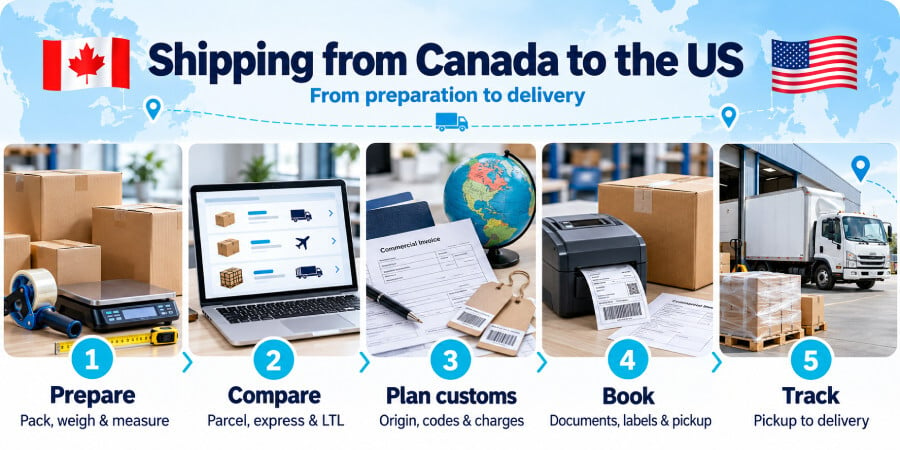
Prepare your product information and customs documents before booking the shipment. This makes it easier to compare suitable services, estimate costs and give your customer realistic delivery expectations.
1. Check Product and Carrier Restrictions
Confirm that your goods can leave Canada, enter the United States and travel with your chosen carrier. Food, batteries, cosmetics and other regulated products may require additional approvals or special handling. Government permission does not automatically mean a carrier will accept the shipment.
2. Pack, Measure and Weigh Your Shipment
Use packaging suited to the product’s weight and fragility. Measure the outside dimensions after packing and include all packaging materials in the total weight.
For pallets, record the full dimensions and weight, including the pallet. Accurate measurements help prevent billing adjustments.
3. Confirm the Product Classification and Origin
Identify the appropriate Harmonized System (HS) or US Harmonized Tariff Schedule (HTS) code. Confirm the product’s country of origin and check whether it qualifies for CUSMA preferential treatment.
Keep this information by product or SKU so your team can reuse verified details for future orders.
4. Choose the Right Shipping Service
Compare available services using the packed dimensions, weight, destination and delivery deadline. Consider tracking, pickup options and customs-clearance arrangements alongside the transportation price.
For several heavy cartons going to one address, compare parcel shipping with a palletized freight option.
5. Arrange Customs Clearance and Duty Payment
Identify the importer of record—the party responsible for the US import entry. Confirm whether the selected service includes brokerage or whether you need a separate customs broker.
Decide who will pay applicable import charges, and explain any customer responsibility before dispatch.
6. Complete and Submit the Required Documents
Prepare the commercial invoice and any product-specific permits or certifications. Freight shipments generally also need a bill of lading.
Check that product descriptions, quantities, values and recipient details match across the shipment records. Submit documents electronically where supported, or attach printed copies as instructed by the carrier.
7. Review the Booking and Label the Shipment
Verify the complete delivery address, ZIP code, contact details and selected service. Attach the correct label to each package and remove old shipping labels before pickup or drop-off.
8. Track Delivery and Keep Your Records
Monitor tracking and respond promptly if the carrier or broker requests information. Share tracking with your customer and retain the invoice, customs documents and delivery confirmation for future reference.

Choosing the Right Canada-to-US Shipping Service
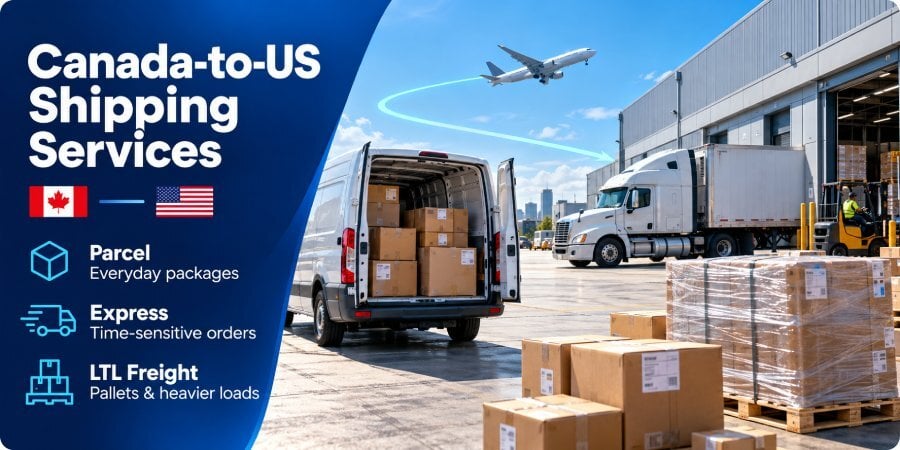
The right shipping service depends on your shipment’s size, delivery deadline and total cost. Ground parcel often suits routine online orders, while express services suit urgent deliveries. Larger orders may be better suited to palletized freight.
Compare services for each shipment rather than choosing the same option for every US order.
Ground Parcel Shipping
Ground parcel is a practical starting point for non-urgent e-commerce orders and business packages. It can offer a lower transportation price than express, particularly when your customer has a flexible delivery deadline.
Check package limits, tracking, delivery estimates and customs-clearance fees before booking. A lower quoted rate does not necessarily mean a lower total cost.
Express Shipping
Express services are worth comparing when a missed delivery deadline would cost more than the shipping upgrade. Common examples include replacement parts, product samples and urgent customer orders.
Confirm availability for the exact origin and destination. An express service still requires complete customs information; paying for faster transportation does not prevent a customs hold.
Economy Shipping Options
Some carriers offer economy or deferred services for shipments with flexible arrival dates. “Economy” describes a service level rather than one specific transportation method.
Compare the estimated arrival date, tracking and included services. Check what the lower price excludes, especially customs-related charges.
LTL Pallet Shipping
Less-than-truckload (LTL) shipping lets your freight share trailer space with other shipments. It is worth comparing when goods are heavy, bulky or packed across several cartons going to one destination.
Include pallet preparation and delivery requirements in the comparison. Residential delivery, appointments and a liftgate—a platform used to lower freight from the truck—can affect the quote.
Full Truckload and Specialized Freight
Full truckload (FTL) may suit larger commercial loads that need dedicated trailer space. Oversized, temperature-sensitive or unusual goods may require specialized equipment and a separate service assessment.
Freightcom provides access to cross-border parcel and freight services, allowing businesses to compare available options for different shipment sizes and delivery needs.
How Much Does Shipping from Canada to the US Cost?
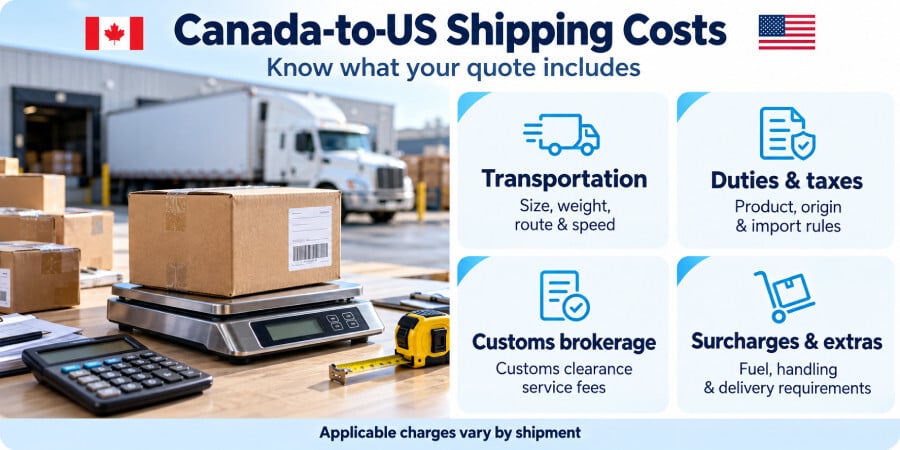
Shipping from Canada to the US has no single flat rate. The price depends on the origin, destination, packed dimensions, weight and service selected. To get a useful quote, enter the complete shipment details and check which transportation and customs charges are included.
What Affects Your Shipping Rate?
The main cost factors include:
- Origin and destination: The shipping route and delivery area affect pricing.
- Package size and weight: Carriers may charge using actual or dimensional weight, whichever is higher. Dimensional weight reflects the space a package occupies.
- Delivery speed: Express services generally cost more than less urgent options.
- Number of packages: Several cartons may be priced differently from a single package or pallet.
- Delivery requirements: Residential addresses, remote areas, appointments and freight liftgate services may add charges.
- Additional services and surcharges: Fuel, oversize handling, pickup, shipment protection and seasonal demand fees may affect the total.
A large, lightweight box can cost more than a smaller, heavier package because of dimensional weight. Measure the finished package rather than estimating from the product alone.
Shipping Cost vs. Total Landed Cost
The transportation rate is only one part of the cost of delivering an order across the border.
Total landed cost generally includes the goods themselves, transportation, applicable duties and taxes, brokerage, clearance and other relevant expenses. For an e-commerce seller, understanding this total helps protect margins and explain charges at checkout.
Some shipping quotes include certain customs services or prepaid import charges. Others leave those costs to be billed separately. Check the breakdown rather than assuming every quote includes the same items.
How to Get an Accurate Canada-to-US Shipping Quote
Have these details ready:
- Canadian pickup postal code and US delivery ZIP code
- Packed weight, dimensions and package count
- Product description, value, currency and country of origin
- HS or HTS classification
- Delivery deadline and any special handling needs
Use the same details when comparing services. Freightcom lets businesses compare carrier rates and view duty-and-tax estimates for supported US-bound shipments. Review the available options and charge breakdown before booking.
How Long Does Shipping from Canada to the US Take?
Shipping from Canada to the US can take as little as the next business day with certain express services. Ground parcel delivery generally takes several business days, while LTL transit times depend on the route and carrier. Always check the estimate for the exact pickup and delivery addresses before promising an arrival date.
Parcel Delivery Times
With Freightcom, you can compare Canada-to-US parcel shipping options by rate and estimated transit time in one place. Express services may suit urgent orders, while ground or economy options may offer better value when delivery dates are flexible. Available services and estimates depend on the pickup and destination postal codes.
Check the estimated delivery window for each quoted service before booking. Allow time for customs clearance, and review whether the estimate includes any delivery commitment. Accurate shipment details and complete customs documents help reduce avoidable delays.
Cross-Border LTL Transit Times
LTL delivery requires a route-specific estimate. Distance, terminal transfers and the carrier’s schedule affect timing. Freightcom states that its LTL transit estimates exclude pickup day and weekends. Confirm any delivery appointment requirements separately when booking.
What Can Delay Delivery?
Allow extra time for:
- Missed pickup or drop-off cutoffs
- Weekends and holidays
- Customs inspections or requests for information
- Unresolved import charges
- Weather or network disruptions
- Remote destinations or delivery appointments
A transit estimate should not be treated as a guaranteed arrival date. Customs delays can affect even express shipments, and any delivery guarantee remains subject to the selected service’s terms.
For online orders, separate your own processing time from carrier transit time. If packing takes two business days, include that time in the delivery window shown to your customer.
Documents Required for Shipping from Canada to the US
Most commercial goods shipments require a commercial invoice and a shipping label or transport document. Additional paperwork depends on what you are shipping, how it travels and whether you are claiming preferential duty treatment. Preparing these documents before pickup helps prevent avoidable customs delays.
Commercial Invoice
The commercial invoice tells customs what you are shipping, who is involved in the transaction and how much the goods are worth. Include specific product descriptions, quantities, values and currency, along with the relevant classification and origin information.
A retail receipt or order confirmation may not contain enough information for customs clearance. www.ecfr.gov
Shipping Label or Air Waybill
Parcel shipments need a shipping label or air waybill with the sender, recipient, service and tracking details. Check that addresses and shipment information match your customs documents.
The shipping label does not replace the commercial invoice.
Bill of Lading for Freight
Pallet and LTL shipments generally require a bill of lading (BOL). It identifies the shipper, recipient, goods, shipment weight and handling instructions.
Provide complete details, including any delivery appointment or liftgate requirements, when booking.
CUSMA Certification of Origin
If your goods qualify for CUSMA preferential treatment, confirm the supporting documentation required for the claim. There is no single mandatory certificate format. Where certification is required, it must include the agreement’s nine minimum data elements.
Permits and Additional Documents
Regulated products may need permits, licences, certificates or other supporting information. Check the requirements for your specific goods before booking.
A Canadian export declaration is generally not required for goods exported for consumption in the United States. However, required permits still apply, and goods travelling through the US to another country follow different reporting rules
Prepare Your Shipment with Freightcom
Freightcom’s cross-border shipping services include parcel and LTL options, with automated documentation available for selected services and partners. Our shipping team can help you understand the booking process and prepare for your next US-bound shipment.

How to Complete a Commercial Invoice
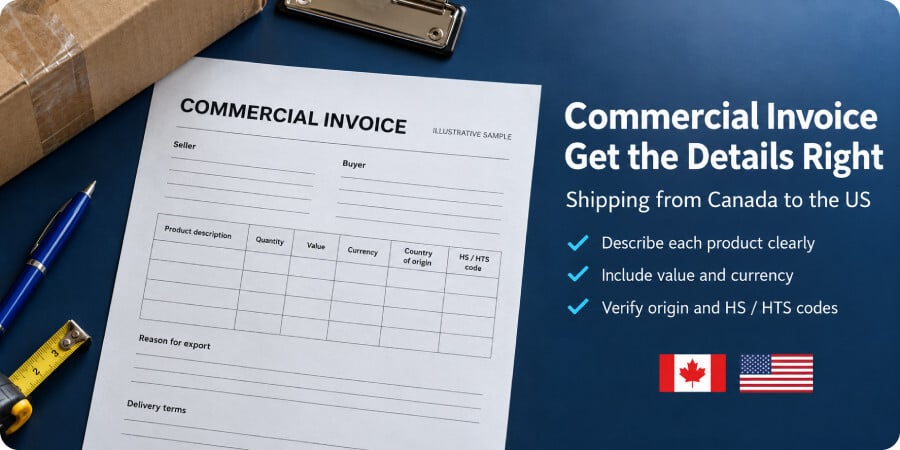
Complete your commercial invoice using accurate transaction and product information. Each line should clearly identify the goods, their quantity, value and origin. Avoid copying vague descriptions from your online store or treating the invoice as a packing list.
1. Identify the Parties Involved
Enter the seller’s and buyer’s names, full addresses and contact details. Include the shipper, delivery recipient and importer of record where these differ. Supply any identification numbers required for the customs entry through the appropriate secure process.
2. Describe Each Product Clearly
Explain what the item is, what it is made of and its intended use where relevant. List different products separately.
Too vague: “Clothing”
More specific: “Men’s knitted T-shirts, 100% cotton, size medium”
“Sample,” “gift” and “replacement” describe the shipment’s purpose. They do not identify the product.
3. Enter the Product and Transaction Details
For each product line, provide:
- Quantity and unit of measure
- Unit price and total line value
- Currency, clearly identified as CAD, USD or another currency
- Country of origin
- Verified HS or HTS classification
Complete the remaining shipment fields, including the reason for export and agreed delivery terms. Show freight, insurance, packing charges and discounts as required. Use English or provide an accurate English translation. ecfr.gov
4. Declare Values Accurately
For a straightforward sale, start with the actual price paid or payable by the US buyer—not your production cost or an invented lower amount. Customs valuation rules may require adjustments.
Free samples and warranty replacements still need an appropriate customs value. Do not automatically enter zero because the recipient is not paying. Confirm the valuation method when no sale has occurred.
5. Review Before Submitting
Check calculations, currency, addresses and package contents against the booking details. Confirm that every product is included and complete any required certification or signature.
Submit the invoice through the supported documentation process and attach printed copies if instructed. Keep a copy with your shipment records.
How HS Codes and Country of Origin Affect Shipping from Canada to the USA
HS codes and country of origin help determine the duties and import requirements that apply to your goods. Accurate information supports reliable landed-cost estimates and reduces the risk of customs corrections.
Understanding HS and HTS Codes
The Harmonized System (HS) uses internationally standardized six-digit codes to classify traded products.
The US Harmonized Tariff Schedule (HTS) extends that system with additional digits. US import entries generally use a ten-digit classification to identify goods more precisely.
Canadian and US tariff codes may share the first six digits, but the remaining digits can differ. Verify the US classification rather than copying the full Canadian code into your shipment documents.
Finding the Right Code for Your Product
Identify the product’s materials, construction and intended use. Search the official US Harmonized Tariff Schedule, then read the relevant descriptions and legal notes.
A close keyword match does not confirm the correct classification. For example, a product’s material can place it in a different category from similar-looking items.
The CBP Customs Rulings database can help you research comparable goods. If uncertainty remains, consult a licensed customs broker or request a CBP binding ruling.
Confirming the Country of Origin
Country of origin depends on where goods were grown, produced or manufactured under the applicable rules. Your Canadian warehouse address does not establish Canadian origin.
For example, importing a finished mug into Canada and simply repacking it for a US customer does not make it Canadian-origin.
When manufacturing involves several countries, review the production process carefully. Rules for origin marking, additional tariffs and CUSMA eligibility may differ.
Keep verified classifications and origin details in your product records. Review them whenever suppliers, materials or manufacturing locations change, rather than reusing information that may no longer apply.
Understanding Duties and Customs Fees When Shipping from Canada to the US
Import charges can affect your profit margin and the price your customer pays. Before shipping, distinguish government charges from the service fees charged for customs clearance. They cover different costs, and paying one does not automatically cover the others.
Duties and Additional Tariffs
Customs duty depends on the product’s HTS classification, customs value, origin and eligibility for preferential treatment. Some goods may also face additional tariffs or trade measures.
There is no single duty percentage for all Canadian shipments. CUSMA eligibility may reduce certain duties, but it does not automatically remove every additional tariff.
Brokerage and Clearance Fees
Brokerage fees pay for services such as preparing and submitting customs entries. These are separate from duties collected by the government. Customs brokers are private businesses and charge for their work.
Depending on the service, standard clearance may be included in the transportation price or billed separately. Additional work, such as processing complex entries, may carry extra charges. Ask what the selected service includes before comparing quotes.
Other Charges to Check
Review the quote and service terms for:
- Advancement or disbursement fees: Charges that may apply when a provider pays import charges on your behalf.
- Government processing fees: Charges that may depend on the entry type and applicable exemptions.
- Storage or handling: Costs that may arise when a shipment needs additional handling or remains on hold.
- Return charges: Costs associated with refused or undeliverable shipments.
These charges do not apply to every shipment.
Plan the Customer’s Total Before Dispatch
Confirm which charges are prepaid, which may be billed later and who is responsible for payment. For online orders, explain any recipient-paid charges before checkout.
When booking through Freightcom, review the available duty-payment options and charge breakdown. This helps you compare the full shipping arrangement rather than choosing solely on the transportation rate.
How CUSMA Can Affect Duties When Shipping from Canada to the US
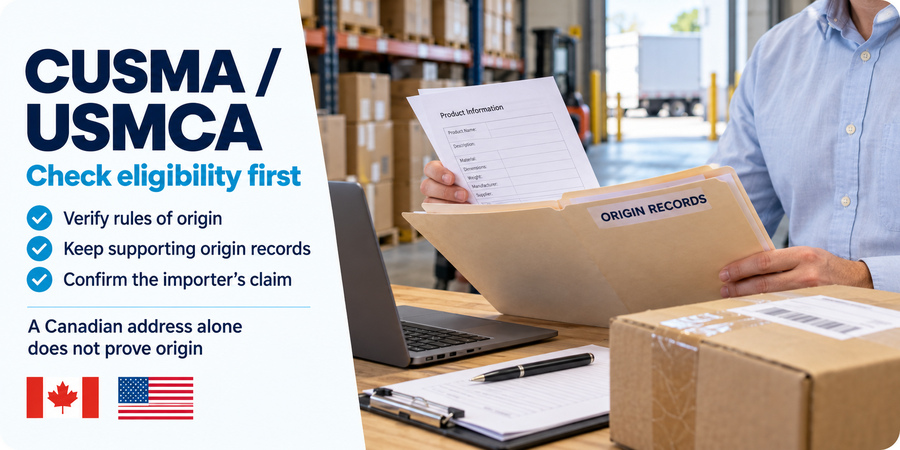
Qualifying goods can receive reduced or eliminated customs duties under the Canada-United States-Mexico Agreement (CUSMA), known as USMCA in the United States. The product must meet the applicable origin rules, and the importer must properly claim preferential treatment. Shipping from a Canadian address does not establish eligibility.
Which Products Qualify for CUSMA?
CUSMA eligibility depends on how goods are grown, produced or manufactured. Products made with imported materials may qualify if they satisfy the relevant rules, which can include:
- Tariff classification changes: Manufacturing turns imported materials into a product with the required different classification.
- Regional value content: The product meets a specified requirement for North American content.
- Production requirements: Particular manufacturing operations take place within North America.
For an online store selling both Canadian-made and imported finished goods, assess each product separately. Buying an item from a Canadian supplier does not prove it qualifies.
CUSMA also does not automatically remove every additional tariff or customs-related fee. Confirm the treatment of the specific goods before advertising duty-free delivery. Tradecommissioner.gc.ca
How Do You Claim CUSMA Preferential Treatment?
Start with the product’s verified classification and identify the applicable origin rule. Obtain supporting information from the manufacturer or supplier before making a claim.
Where certification is required, the producer, exporter or importer can complete it using an adequate basis for confirming eligibility. The importer must hold the certification when claiming the preference and provide supporting documents if CBP requests them. Certification-submission exceptions do not remove the requirement for the goods to qualify.
What Records Should Your Business Keep?
Maintain a product file containing the certification, supplier declarations and relevant material or production records. This helps support repeat shipments without rebuilding the evidence for every order.
Reassess eligibility when materials, suppliers or manufacturing processes change. A certification based on the previous production arrangement may no longer support your claim.
Resolve uncertain origin questions with a customs broker before booking, then use the confirmed product details when preparing your shipment through Freightcom.
Choosing Between DDP and DAP When Shipping from Canada to the US
Before shipping, agree on who will handle US import clearance and pay duties, taxes and related fees. DDP and DAP define these responsibilities between the seller and buyer. Your shipping settings should match that agreement.
DDP vs. DAP: Who Is Responsible?
|
Responsibility |
DDP — Delivered Duty Paid |
DAP — Delivered at Place |
|
Arrange and pay for transportation to the named destination |
Seller |
Seller |
|
Handle US import clearance |
Seller |
Buyer |
|
Pay applicable import duties and taxes |
Seller |
Buyer |
|
Delivery and transfer of transport risk, subject to the rule’s exceptions |
At the named destination, ready for unloading |
At the named destination, ready for unloading |
Under both rules, the seller handles export clearance where required. DDP adds responsibility for import clearance and applicable import charges. Before offering DDP, establish how those obligations will be fulfilled, including the importer-of-record arrangements.
Why Freightcom Uses the DDU Label
DDU means Delivered Duty Unpaid. It is a legacy term that is no longer included in the current ICC Incoterms rules. DAP is the relevant current rule when the seller arranges delivery to a named destination and the buyer handles import clearance and charges.
Freightcom uses DDU — Billed to Receiver to identify its receiver-paid duties and taxes option. This billing label does not automatically establish all the contractual obligations of a DAP sale. Keep the agreed sales terms, commercial invoice and shipment billing instructions consistent.
For supported shipments, Freightcom also offers DDP — Bill to Shipper, with estimated duties and taxes displayed during quoting. If a receiver refuses delivery or leaves duties, taxes or brokerage unpaid under DDU billing, resulting charges can be billed back to your Freightcom account.
Choose the Arrangement That Fits Your Customer
DDP can help provide a more predictable purchasing experience for US consumers. DAP may suit business customers that already manage their own imports.
Whichever arrangement you choose, explain any customer-paid import charges before checkout or order approval, and review the selected service’s inclusions before booking.

Who Is the Importer of Record When Shipping from Canada to the US?
The importer of record (IOR) is the party responsible for ensuring that goods entering the United States comply with applicable import requirements. This includes accurate customs information and payment of duties owed. The IOR is not automatically the person receiving the package or the party selected to pay shipping charges.
What Does the Importer of Record Handle?
The IOR is accountable for:
- Accurate product classification, customs value and origin
- Required import documentation and regulatory compliance
- Applicable duties and customs charges
- Supporting records and responses to customs enquiries
A customs broker can prepare and submit entries on the importer’s behalf. Hiring a broker does not remove the importer’s responsibility for compliance.
Can a Canadian Business Be the Importer?
Yes. A Canadian business may act as a non-resident importer, provided it meets the applicable US requirements. Before your first shipment, confirm the identification, representation and customs-bond arrangements required for your entry with a licensed US customs broker.
An eligible US buyer or distributor may instead take responsibility. Agree on the arrangement before dispatch rather than assuming the delivery address determines the importer.
What About Marketplaces and Fulfilment Centres?
A warehouse receiving your inventory is not automatically accepting responsibility for importing it. Do not name a marketplace, fulfilment centre or logistics provider as the IOR without confirming its eligibility and agreement.
For example, sending stock to a US fulfilment warehouse may require your Canadian business to arrange import clearance before the warehouse receives it.
Before booking through Freightcom, confirm who will act as the IOR, whether the broker has the necessary authorization and which importer details must accompany the shipment.
What Can and Cannot Be Shipped from Canada to the US?
Many business products can cross the border with accurate documentation, but some goods are prohibited or need additional checks. Before booking, confirm that the product can legally leave Canada, enter the United States and travel through the selected shipping service.
A product being available for sale in Canada does not establish US import eligibility.
Prohibited vs. Restricted Goods
Prohibited goods cannot legally enter the United States under the applicable rules.
Restricted or regulated goods may be permitted if they meet specific conditions, such as permits, registrations, labelling requirements or inspections. Requirements can depend on the ingredients, materials, intended use and country of origin.
Products That Need Extra Checks
Review requirements carefully when shipping:
- Food and supplements: FDA requirements may apply, including prior notice for food shipments unless an exemption applies.
- Cosmetics and medical products: Ingredients, labels, product claims and regulatory status can affect admissibility.
- Plants, seeds and animal products: Agricultural restrictions vary by commodity and origin.
- Batteries, aerosols and chemicals: Transport restrictions and dangerous-goods requirements may apply.
- Alcohol, tobacco and firearms: These require specific eligibility checks and may be unavailable through the selected service.
Commercial shipments must meet the relevant agency requirements; guidance for travellers carrying personal goods should not be treated as instructions for business orders. FDA
Check Freightcom’s Shipping Restrictions Before Booking
Government permission does not guarantee carrier acceptance. Freightcom’s courier restrictions include items such as alcohol, tobacco, batteries and dangerous goods. Other categories may require pre-approval or move at the shipper’s risk.
Review our prohibited and restricted items before preparing your shipment. If acceptance is unclear, contact Freightcom with the exact product details before booking.
Shipping E-commerce Orders from Canada to US Customers
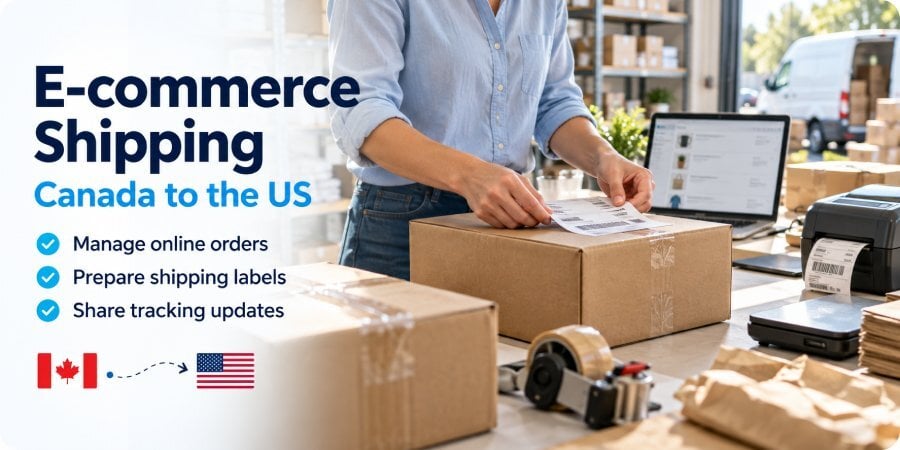
Shipping US orders consistently starts before an order reaches your packing station. Your checkout, product records and fulfilment process should agree on the delivery service, expected arrival window and responsibility for import charges.
For Shopify, WooCommerce and other online sellers, the goal is a repeatable process that protects your margin and gives customers clear expectations.
Set Clear Expectations at Checkout
Show the available shipping options and explain whether applicable import charges are included or payable separately. Separate your processing time from the carrier’s transit estimate.
Make your US returns policy easy to find. Customers should understand who pays return shipping and how to request a return before purchasing.
Prepare Product Data for Repeat Orders
Maintain verified customs information for each SKU, alongside accurate product weights and packaging details. This reduces repeated data entry and makes it easier to prepare consistent shipping documents.
Review orders containing bundles, multiple boxes or products from different countries. These may need different packaging or separate customs line items.
Connect Your Store to Freightcom’s Shipping Services
ClickShip by Freightcom connects supported storefronts and marketplaces so you can manage orders, compare parcel and pallet services, prepare shipment documents and follow tracking in one place. Eligible integrations also support real-time shipping rates at checkout.
Before enabling your US shipping options, test representative orders. Check the services displayed, packed dimensions, customs information and charge breakdown. Confirm that your customer-facing checkout matches the shipping arrangement you intend to book.
Keep Customers Informed After Dispatch
Send tracking when the shipment is dispatched and monitor delivery exceptions. If customs requests information, assign someone on your team to respond promptly.
For growing stores, reviewing recurring delays and billing adjustments can reveal which product records or shipping rules need attention.
Explore Freightcom’s e-commerce shipping solutions to find the right setup for your online store.
Managing Returns After Shipping from Canada to the US
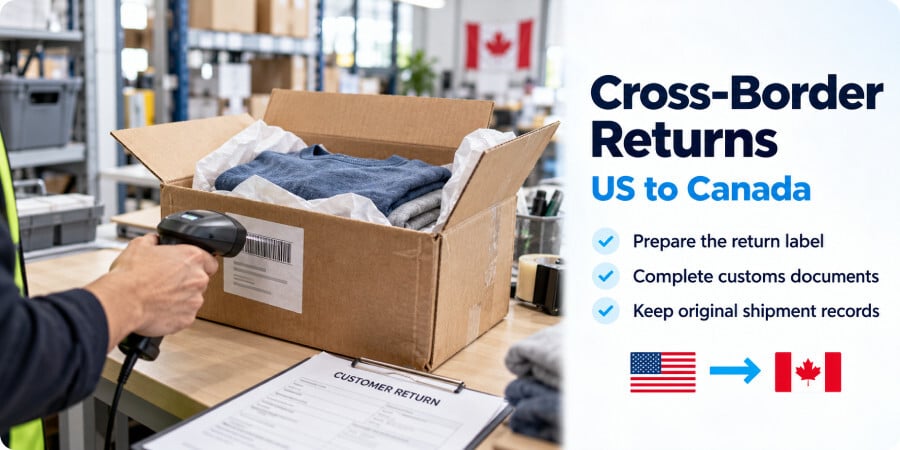
A cross-border return is another international shipment. When a US customer sends goods back to Canada, the package needs accurate customs information and a suitable return service. Plan this process before accepting US orders so customers know what to do and your team can manage the costs.
Give Customers Clear Return Instructions
Explain how to request authorization, where to send the goods and who pays return shipping. Provide packing instructions and the required label and customs documents.
Ask customers to remove old shipping labels and use the documents prepared for the return. They should not mark a commercial return as a gift.
Connect the Return to the Original Shipment
Keep the original invoice, tracking record and proof of export. Identify the returning products using descriptions, quantities, SKUs and serial numbers where applicable.
State the actual reason for the shipment, such as “customer return” or “return for repair,” alongside a specific product description. These records help establish that the goods returning to Canada are the same goods previously exported.
Check Duty Relief Before the Return Ships
Goods returning to Canada may qualify for customs-duty relief if the relevant conditions are met. Tax relief has separate requirements. Goods repaired, improved or combined with other goods abroad may require different treatment.
Neither a return label nor the words “returned goods” automatically establish an exemption. Confirm eligibility and supporting documents with your customs broker before dispatch. cbsa-asfc.gc.ca
Treat a replacement sent to the US as a separate shipment with its own documentation.
Before giving your customer return instructions, ask Freightcom about available US-to-Canada shipping options and confirm the required customs arrangements.
Shipping Pallets and LTL Freight from Canada to the US
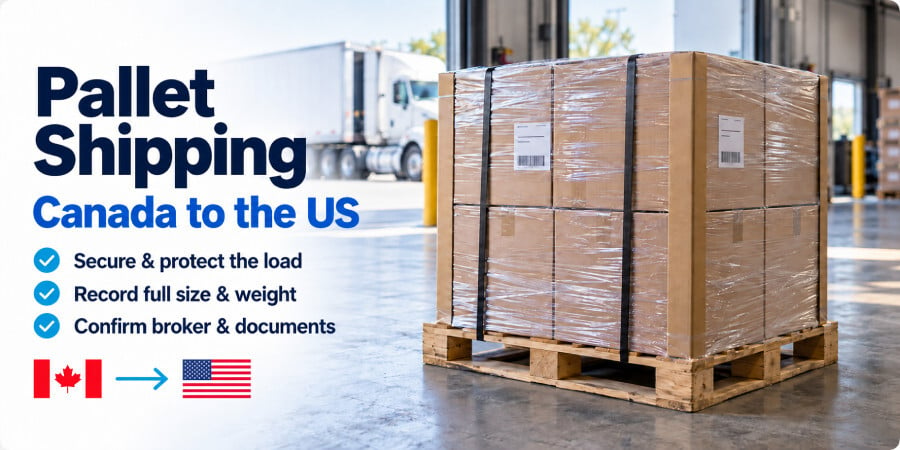
Less-than-truckload (LTL) shipping lets your goods share trailer space with other shipments. It is worth comparing when an order is too heavy, bulky or costly to send as individual parcels, particularly for wholesale orders, equipment and retail replenishment.
Prepare the Details for an Accurate Freight Quote
Have the following information ready:
- Pickup postal code and delivery ZIP code
- Number of pallets or handling units
- Full dimensions and weight of each loaded pallet
- Specific commodity description and freight class, where required
- Whether the freight is stackable
- Loading docks, forklifts and additional services needed at either address
Include the pallet and packaging in your measurements. Incorrect dimensions, weight or commodity details can lead to billing adjustments.
Pack for Multiple Handling Points
LTL freight may pass through several terminals. Use a sound pallet, keep goods within its edges and secure the load with suitable wrapping or strapping. Protect corners and fragile surfaces, and label each handling unit clearly.
Check wood-packaging requirements before shipping. Qualifying Canadian or continental US wood packaging may be exempt from ISPM 15 treatment and marking requirements when the required conditions and documentation are met. Other wood packaging may require compliant treatment and markings. inspection.canada.ca
Arrange Customs Clearance Before Pickup
For cross-border pallet shipments booked through Freightcom, arrange a licensed customs broker before dispatch. Confirm the importer of record and provide the broker with the commercial invoice and supporting documents.
Prepare the bill of lading using details consistent with the booking and invoice. Confirm that the broker and carrier have the information needed for border clearance; a freight booking alone does not complete the customs arrangements.
Confirm How the Recipient Will Receive the Freight
Ask whether the destination has a loading dock or forklift. If not, a liftgate may be needed. Residential addresses, limited-access locations, inside delivery and appointments must be identified when requesting rates.
Check what the selected service includes, and give the recipient clear receiving instructions.
Compare Freightcom’s cross-border LTL shipping options using your pallet details, delivery requirements and customs arrangements.
How to Reduce Shipping Costs from Canada to the US
Lower shipping costs come from matching services to your orders, using suitable packaging and preventing avoidable charges. Compare the total cost of getting goods to the customer, including import-related fees, rather than choosing solely on the lowest transportation rate.
Compare Services for Each Order
Check available services against the customer’s actual delivery deadline. An express upgrade adds little value when a less expensive service meets the same requirement.
Freightcom gives businesses access to negotiated carrier rates and lets you compare options by price and speed. The best choice may differ between destinations and package sizes.
Reduce Unused Packaging Space
Use the smallest suitable packaging that still protects the product. Excess space can increase dimensional weight and trigger higher charges.
For frequently shipped products, test a few packaging options and save accurate packed measurements. Cutting protective materials too far can increase damage and replacement costs, cancelling out the saving.
Compare Combined Orders and Pallet Options
When products are going to the same customer, compare shipping them together with sending separate packages. Consider the final dimensions, handling requirements and delivery deadline.
For several heavy cartons, compare parcel pricing with LTL. Include pallet preparation, brokerage and any additional delivery services in the calculation.
Review the Costs That Keep Reappearing
Compare booked quotes with final invoices. Look for repeated:
- Weight or dimension adjustments
- Address corrections and redelivery charges
- Oversize or additional-handling fees
- Storage, return or refused-delivery costs
Fix the underlying cause in your product records, checkout or packing process. Review results by destination and package type so one unusually expensive shipment does not drive your entire shipping policy.
Use these findings when comparing your next shipment through Freightcom.
Why Shipments from Canada to the US Get Delayed at Customs
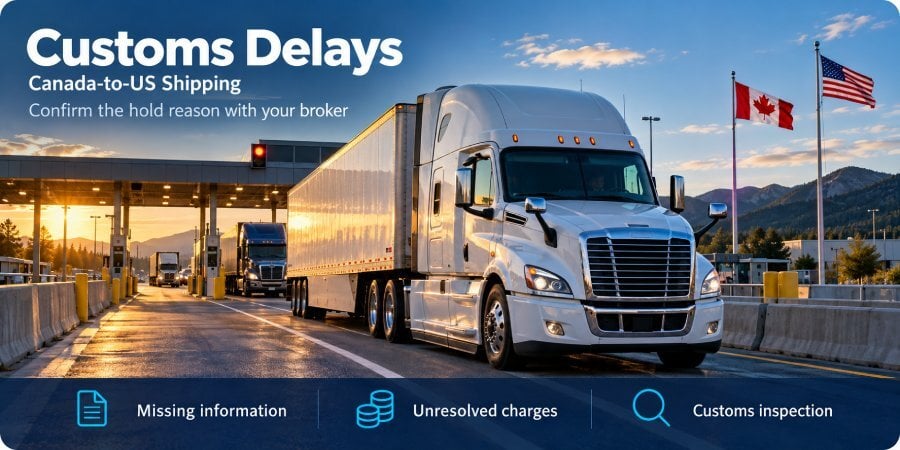
A customs delay usually means the shipment needs further information, payment or inspection before it can be released. Accurate paperwork can prevent many avoidable holds, but a correctly prepared shipment may still be selected for examination.
Common Reasons for a Customs Hold
Delays can arise from:
- Incomplete invoices: Missing quantities, values, currency or party details.
- Unclear product information: Vague descriptions or classification and origin details that need verification.
- Unresolved import charges: Required payment or payment arrangements have not been completed.
- Regulated products: Missing permits, registrations or agency-specific information.
- Importer information issues: Customs needs additional identification or supporting records.
- Compliance inspections: Authorities examine the goods or investigate concerns about admissibility or authenticity. help.cbp.gov
What to Do When Your Shipment Is Delayed
Start by confirming the actual reason for the delay. A tracking exception alone may not explain which party needs to act.
- Check the latest shipment status and any requests sent to the shipper, importer or recipient.
- Contact Freightcom or the appointed customs broker with the shipment reference and tracking number.
- Ask exactly what is outstanding and who must provide it.
- Submit the requested information promptly, keeping corrections consistent across the relevant documents.
For shipments booked through Freightcom, you can review tracking in the platform before requesting assistance.
If customs issues a formal notice, follow its instructions and response deadline with your broker. Keep the customer informed, and obtain an updated delivery estimate once the hold is resolved.
How Freightcom Simplifies Shipping from Canada to the US
Freightcom brings carrier comparison, booking and shipment management into one platform. You can compare services for a single customer order or a pallet shipment without managing each carrier through a separate account and workflow.
Compare Parcel and LTL Services in One Place
Enter your shipment details to view available services and negotiated rates. Compare price, estimated transit time and delivery requirements before choosing an option.
For example, a growing Canadian brand may send individual parcels to US shoppers and larger replenishment orders to retailers. Freightcom supports both parcel and cross-border LTL shipping, giving the business options as its shipment sizes change.
Prepare Documents and Review Import Costs
Freightcom offers automated documentation for selected services and partners, alongside in-platform duty-and-tax estimates for supported US-bound shipments.
This helps you review the shipping arrangement before booking, including available duty-payment options. Your product descriptions, values, classifications and origin information still need to be accurate.
Keep Tracking, Billing and Support Together
Manage shipments and follow tracking through Freightcom rather than switching between carrier websites. Consolidated billing also makes it easier to review shipping expenses across services.
When you need assistance, our shipping team can help with booking questions, service options and shipment enquiries. For cross-border freight, confirm your customs-broker arrangements before dispatch.
Start with Your Next US-Bound Shipment
Have your pickup and delivery addresses, packed measurements and customs information ready. Compare the available options against your budget and customer’s deadline, then book the service that fits.
Your Checklist for Shipping from Canada to the US
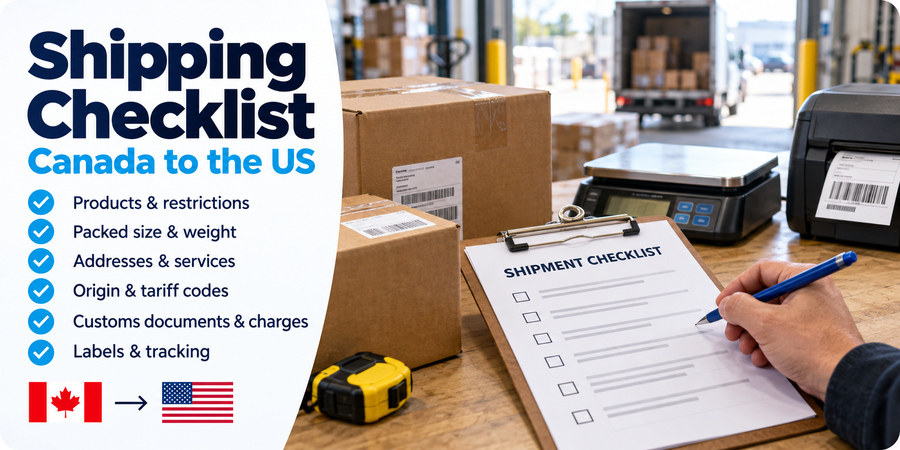
Use this checklist before booking and again before pickup to catch missing information while there is still time to correct it.
Before Requesting Rates
- Confirm the product meets Canadian export rules, US import requirements and shipping-service restrictions.
- Pack the goods securely and record the full dimensions, weight and package count.
- Verify the delivery address, ZIP code and recipient’s contact details.
- Identify any appointment, liftgate or special-handling requirements.
- Compare services against the customer’s delivery deadline and total cost.
Before Dispatch
- Check product descriptions, quantities, customs values and currency.
- Verify HS or HTS classifications and country of origin.
- Confirm CUSMA eligibility and supporting documentation where applicable.
- Establish the importer of record and any required broker arrangements.
- Confirm who pays duties and import fees.
- Complete the commercial invoice, permits and freight documents as required.
- Check that labels, booking details and customs documents agree.
After Pickup
- Share tracking with the customer and monitor exceptions.
- Respond promptly to documentation requests.
- Retain shipment records and review any billing adjustments.
Frequently Asked Questions About Shipping from Canada to the US
1- What Is the Cheapest Way to Ship from Canada to the US?
The cheapest option depends on the packed size, weight, destination and delivery deadline. Compare available ground and economy services through Freightcom, including surcharges and import-related costs, before choosing.
2- How Much Does Shipping from Canada to the US Cost?
There is no universal rate. Request a quote using accurate package measurements, weight and addresses. For freight, include pallet details and additional delivery requirements. Check which customs charges are included.
3- How Long Does Shipping from Canada to the US Take?
Certain express services offer next-business-day delivery to eligible destinations. Ground shipping generally takes several business days, while LTL requires a route-specific estimate. Allow for order processing and possible customs delays.
4- Do I Need a Commercial Invoice When Shipping from Canada to the US?
Most commercial shipments from Canada to the US require a commercial invoice for customs clearance. It identifies the seller and buyer, describes the goods, and states their quantities, values, currency and country of origin. Prepare it before pickup and check that the details are consistent with your shipping records. A shipping label or packing list alone does not replace a required commercial invoice.
5- Are Shipments Under US$800 Automatically Duty-Free?
No. The duty-free de minimis exemption has been suspended. Low-value commercial shipments may still attract applicable duties, taxes and fees. A shipment’s value alone does not establish duty-free eligibility. govinfo.gov
6- Are Canadian-Made Goods Duty-Free Under CUSMA?
Qualifying goods may receive preferential tariff treatment, but Canadian manufacture alone does not establish eligibility. The product must meet the applicable origin rules, and the importer must properly claim the preference. Additional tariffs or fees may still apply.
7- Who Pays Customs Charges When Shipping from Canada to the US?
Under DDP, the seller handles import clearance and applicable import charges. Under DAP, those obligations fall to the buyer. Confirm the selected service’s billing conditions and explain any recipient-paid charges before purchase.
8- Do I Need a Customs Broker to Ship from Canada to the US?
For shipping from Canada to the US, customs brokerage depends on the service. Freightcom’s cross-border pallet and LTL shipments require a licensed customs broker, while courier partners handle parcel clearance. Confirm brokerage fees before booking. The importer remains responsible for accurate documents and customs compliance.
9- Can I Ship Food from Canada to the US?
Some food products can be imported if they meet applicable FDA, agricultural and other requirements. Prior notice is generally required unless an exemption applies. Confirm product eligibility and shipping-service acceptance before booking. FDA
10- How Do I Find the Correct HS or HTS Code?
Identify the product’s materials, construction and intended use, then review the US tariff schedule and relevant legal notes. Do not rely on a keyword match alone. Ask a customs broker when classification is uncertain.
11- Can I Ship a Pallet from Canada to the US Through Freightcom?
Yes. Freightcom offers cross-border LTL options. Provide loaded pallet dimensions, weight, commodity details and delivery requirements, then confirm your customs broker and documentation arrangements before pickup.
12- Can Freightcom Help with Shopify Orders Going to US Customers?
Yes. ClickShip by Freightcom connects supported online stores, including Shopify, to shipping services and fulfilment tools. Available features include order management, rate comparison, shipment documents and tracking, depending on the integration and setup.
13- How Do I Handle a US Customer’s Return to Canada?
Prepare a separate return shipment with accurate customs information and references to the original export. Explain the return reason and retain supporting records. Confirm any duty or tax relief before shipping; a return label alone does not establish eligibility.
14- Do I Need Shipping Insurance When Shipping from Canada to the US?
Consider shipping insurance if the carrier’s liability limit would not cover the value of your goods. Carrier liability and shipping insurance provide different protection. Before booking a Canada-to-US shipment, review coverage limits, exclusions, deductibles and packaging requirements, particularly for valuable or fragile items.
15- What Should I Do If My Canada-to-US Shipment Is Held at Customs?
Check the tracking update and contact the carrier or customs broker to identify what is needed. Respond promptly to requests for invoice corrections, product details or importer information. Confirm who will provide the missing information, and update your customer’s delivery expectations while clearance is pending.