



Shipping from Canada to the UK is a key international route for businesses involved in eCommerce, retail, manufacturing, and wholesale distribution. Whether you are shipping from Toronto, Vancouver, or Montreal to major UK cities like London, Manchester, or Birmingham, understanding the full process is essential to reduce costs, avoid delays, and improve customer satisfaction.
What Shipping from Canada to the UK Involves
At a high level, international shipping between Canada and the UK includes:
- Transporting goods across borders using reliable shipping methods
- Preparing accurate shipping and customs documentation
- Complying with UK import regulations and requirements
For most businesses, speed and reliability play a major role. This is especially important when managing inventory, fulfilling customer orders, or maintaining consistent delivery timelines.
Why This Route Matters for Businesses
The UK is one of Canada’s major trade partners, making it a high-demand destination for a wide range of products, including:
- Fashion and apparel
- Consumer electronics
- Industrial parts
- Health and wellness products
- General consumer goods
Because of this demand, businesses need a well-structured shipping strategy to stay competitive in the market.
Key Business Priorities When Shipping to the UK
Shipping is no longer just about moving packages, it is about building an efficient and scalable logistics system. Businesses need to:
- Access accurate shipping rates before checkout
- Maintain consistent and predictable delivery timelines
- Avoid customs delays and unexpected charges
- Manage multiple shipments without operational complexity
- Fast delivery
- Clear shipping timelines
- Real-time tracking
These factors directly impact customer experience and long-term growth.
Growing Expectations from UK Customers
UK customers increasingly expect:
Businesses that meet these expectations are more likely to improve conversion rates and retain customers, especially in competitive eCommerce markets.
How Freightcom Supports Business Shipping
Using a shipping platform like Freightcom helps simplify the process by offering:
- Real-time rate comparisons
- Multi-carrier access in one platform
- Automated shipping workflows
- Scalable solutions for both small and high-volume shipments
This allows businesses to streamline operations and focus on growth instead of logistics challenges.

How Long Does Shipping from Canada to the UK Take?
Shipping from Canada to the UK typically takes 2–4 business days with express shipping and 3–7 business days with standard air services, depending on the carrier and service level selected. Economy options may take 1–3 weeks, while surface shipping can take longer. Delivery times may also vary based on customs clearance and the final destination within the UK.
Delivery Time Overview
| Shipping Method | Transit Time | Recommended For |
| Express Shipping | 2–4 business days | Urgent shipments |
| Standard Air | 3–7 business days | eCommerce & business shipping |
| Economy | 1–3 weeks | Cost-sensitive shipments |
| Surface Shipping | Several weeks | Bulk or non-urgent shipments |
Key Factors That Affect Delivery Time
- Customs clearance and documentation accuracy
- Shipment size, type, and handling requirements
- Final delivery location within the UK
- Seasonal demand and logistics conditions
Get Faster Delivery with Freightcom
To speed up your shipping from Canada to the UK:
- Choose express shipping or priority services when needed
- Ensure all documents are accurate and complete
- Use reliable carriers with strong UK networks
With Freightcom, you can compare real-time shipping rates, select faster delivery options, and manage all your shipments in one place.
Get Your Shipping Rates Now
Looking for the fastest and most cost-effective way to ship from Canada to the UK?
Get instant quotes, compare carriers, and start shipping today with Freightcom.
Best Shipping Methods from Canada to the UK
Choosing the right shipping method from Canada to the UK is one of the most important decisions for businesses. The method you choose affects delivery speed, shipping costs, reliability, and overall customer satisfaction.
Main Shipping Options for Canada to UK
Businesses typically choose from two main shipping methods depending on their needs:
Air Freight
Air freight is the most used method for businesses that need fast and reliable delivery. It is ideal for:
- eCommerce orders
- High-value products
- Time-sensitive shipments
- Lightweight to medium-weight goods
Shipments from major Canadian cities like Toronto, Vancouver, and Montreal can reach key UK hubs such as London, Manchester, and Birmingham within a few days. This makes air freight a strong option for businesses that need quick turnaround and consistent delivery performance.
Ocean Freight
Ocean freight is generally used for:
- Large volume shipments
- Heavy or oversized goods
- Non-urgent deliveries
While it offers lower costs per unit, it comes with longer transit times that can extend to several weeks. For businesses focused on speed and flexibility, this option is usually secondary but still valuable for bulk logistics planning.
How to Choose the Right Shipping Method
Selecting the best method depends on your business priorities:
- Speed: Faster options are better for urgent shipments and customer satisfaction
- Cost: Slower methods may reduce costs for bulk shipments
- Flexibility: Some methods offer better tracking and delivery control
Many businesses use a mix of shipping methods depending on the type of product, order size, and delivery urgency.
Simplifying Shipping Decisions with Freightcom
Freightcom helps businesses choose the best shipping method by offering:
- Real-time rate comparisons across multiple carriers
- Flexible options based on speed and cost
- Centralized shipment management
This allows businesses to make informed decisions and optimize their shipping strategy without added complexity.
Shipping from Major Canadian Cities to the UK
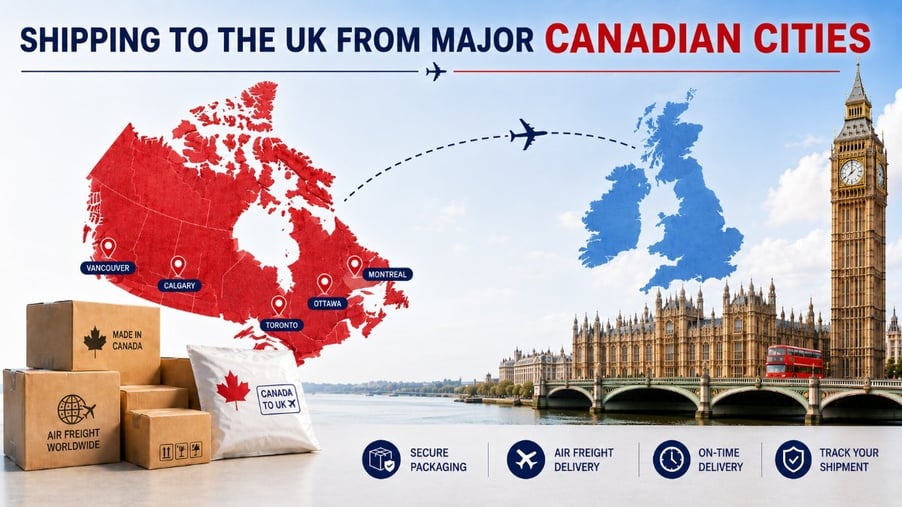
Shipping from Canada to the UK often starts from major logistics hubs such as Toronto, Vancouver, Montreal, and Calgary. Each city plays a key role in international shipping, offering strong infrastructure, frequent departures, and efficient connections to major UK destinations.
Toronto to UK Shipping
Toronto is the largest shipping hub in Canada and a primary gateway for international shipments. Businesses shipping from Toronto benefit from:
- High flight frequency to the UK
- Faster processing and dispatch times
- Strong carrier availability
Most shipments from Toronto are delivered to cities like London, Manchester, and Birmingham within a short timeframe, making it a preferred origin point for many businesses.
Vancouver to UK Shipping
Vancouver serves as a major West Coast hub, ideal for businesses operating in British Columbia and nearby regions. Key advantages include:
- Efficient logistics infrastructure
- Strong international connections
- Reliable handling for outbound shipments
Although slightly farther from the UK compared to Toronto, Vancouver still offers consistent and dependable shipping performance.
Montreal to UK Shipping
Montreal is another important shipping center, especially for businesses in Eastern Canada. It provides:
- Direct access to international shipping routes
- Strong connections to European destinations
- Efficient processing for commercial shipments
Its geographic location makes it a strategic option for businesses targeting UK markets.
Calgary to UK Shipping
Calgary is a growing logistics hub for Western Canada, supporting businesses with:
- Access to major shipping networks
- Reliable transportation connections
- Competitive shipping options
While it may not have the same volume as Toronto or Vancouver, Calgary still provides strong support for international shipments to the UK.
Choosing the Right Origin City
The best shipping origin depends on:
- Your business location
- Inventory storage and warehouse setup
- Carrier availability and rates
In many cases, businesses optimize their operations by shipping from the closest major hub or consolidating shipments through key cities like Toronto or Vancouver.
How Freightcom Supports Multi-City Shipping
Freightcom helps businesses manage shipments from different Canadian cities by offering:
- Access to multiple carriers across regions
- Consistent pricing and service options
- Centralized shipment management
This ensures businesses can scale their operations while maintaining efficiency, regardless of where shipments originate.
Shipping from major Canadian cities like Toronto, Vancouver, and Montreal gives your business access to faster routes, better carrier availability, and more competitive rates when shipping to the UK. Choosing the right origin city and shipping option can help improve delivery speed and reduce overall costs.

Shipping to Major UK Cities from Canada

When shipping from Canada to the UK, the destination city plays an important role in delivery speed, cost, and overall logistics planning. The UK has several major commercial and population centers that serve as key delivery hubs for international shipments.
Shipping to London
London is the primary destination for international shipments entering the UK. As the largest city and economic center, it offers:
- Fast customs clearance due to high shipment volume
- Strong logistics infrastructure
- Easy distribution to surrounding regions
Most businesses prioritize London as their main entry point, especially eCommerce and commercial shipments.
Shipping to Manchester
Manchester is a major business and distribution hub in Northern England. Shipping to Manchester provides:
- Efficient access to northern UK markets
- Strong warehousing and fulfillment networks
- Reliable last-mile delivery options
It is a strategic destination for businesses targeting customers outside of London.
Shipping to Birmingham
Birmingham is centrally located and serves as a key logistics hub within the UK. Key advantages include:
- Central access to multiple regions
- Strong transportation connections
- Efficient distribution capabilities
This makes it an ideal destination for businesses that need broad UK coverage.
Shipping to Glasgow
Glasgow is one of the main cities in Scotland and an important destination for shipments heading north. Businesses shipping to Glasgow benefit from:
- Access to the Scottish market
- Established delivery networks
- Reliable regional distribution
Although transit times may be slightly longer compared to London, it remains a critical destination for expanding businesses.
Shipping to Liverpool
Liverpool is another key city with strong logistics and commercial activity. It offers:
- Efficient handling of inbound shipments
- Access to surrounding industrial regions
- Strong local distribution capabilities
It is often used as an alternative or complementary destination to Manchester.
Choosing the Right UK Destination
The best destination city depends on:
- Your target customer location
- Warehouse or fulfillment center placement
- Delivery time expectations
Some businesses ship directly to multiple cities, while others use one main hub like London and distribute from there.
How Freightcom Supports UK-Wide Delivery
Freightcom enables businesses to ship efficiently to multiple UK cities by offering:
- Flexible carrier options for different destinations
- Reliable transit times across regions
- Centralized tracking and shipment management
This allows businesses to expand into the UK market while maintaining consistent delivery performance.
Shipping Costs from Canada to UK

Understanding shipping costs from Canada to the UK is essential for businesses that want to stay competitive while protecting their margins. Shipping rates can vary significantly depending on several factors, and having visibility into pricing helps businesses make better logistics decisions.
Average Shipping Cost from Canada to the UK
Shipping costs are typically calculated based on:
- Weight of the shipment
- Dimensions (dimensional weight)
- Shipping method and speed
- Origin and destination cities
For smaller parcels, costs are usually calculated per shipment, while larger or commercial shipments are often priced per kilogram. Faster delivery options generally come at a higher cost, but they provide better reliability and shorter transit times.
Cost Differences Based on Shipping Speed
Shipping speed is one of the biggest factors affecting cost:
- Express shipping: Higher cost, fastest delivery
- Standard shipping: Balanced option between cost and speed
- Economy options: Lower cost, longer delivery times
Businesses need to balance speed and cost based on customer expectations and product value.
Dimensional Weight and Its Impact
Carriers often use dimensional weight (also known as volumetric weight) to calculate shipping costs. This means:
- Large but lightweight packages may cost more than expected
- Packaging size directly affects pricing
- Optimizing packaging can significantly reduce costs
This is especially important for eCommerce businesses to ship products like clothing, accessories, or lightweight goods.
Additional Costs to Consider
Beyond base shipping rates, businesses should also consider:
- Customs duties and import taxes
- Fuel surcharges
- Residential delivery fees
- Remote area surcharges
These additional costs can impact the total landed cost of a shipment if not accounted for properly.
How to Reduce Shipping Costs
Businesses can lower their shipping expenses by:
- Comparing multiple carrier rates before shipping
- Optimizing packaging size and weight
- Consolidating shipments when possible
- Choosing the right shipping speed based on urgency
Even small adjustments in packaging or carrier selection can lead to significant savings over time.
How Freightcom Helps Optimize Shipping Costs
Freightcom helps businesses control and reduce shipping costs by offering:
- Real-time rate comparisons across multiple carriers
- Access to discounted shipping rates
- Flexible shipping options based on budget and speed
- Tools to optimize packaging and shipment planning
This allows businesses to make cost-effective decisions while maintaining reliable delivery performance.
Shipping costs from Canada to the UK can vary depending on weight, dimensions, and delivery speed. Having access to real-time pricing allows you to make smarter decisions and choose the best option for your business needs.
Key Factors That Affect Canada to UK Shipping Costs
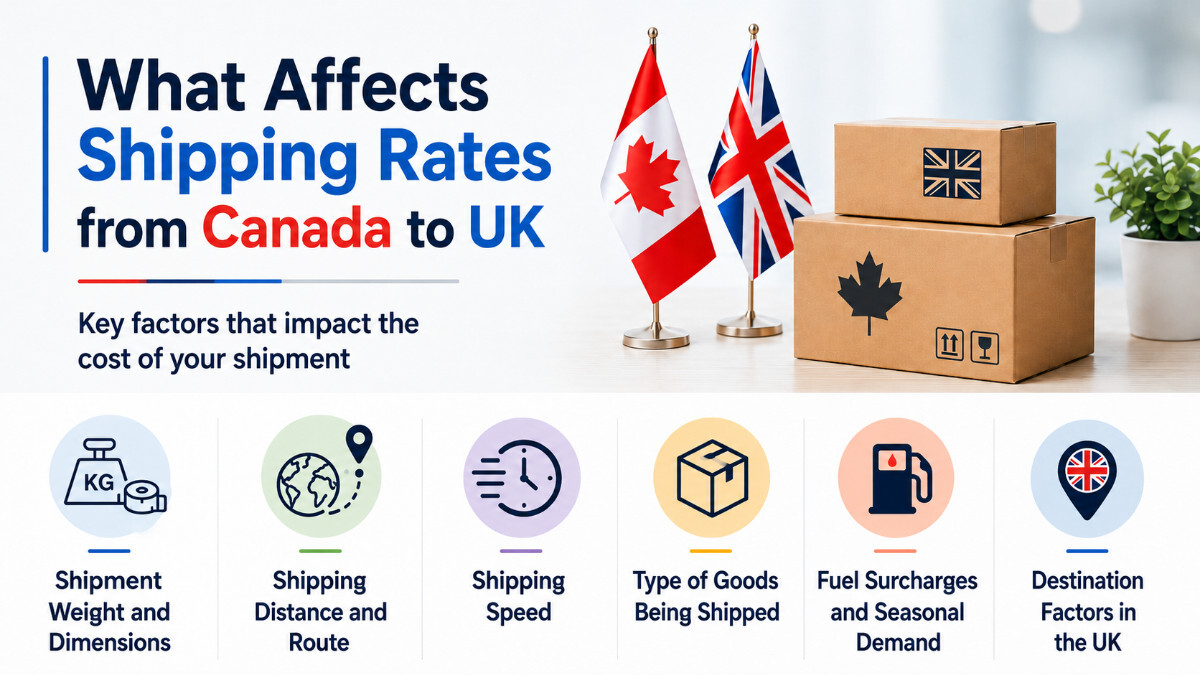
Shipping rates from Canada to the UK are not fixed, they vary based on several key factors. Understanding these variables helps businesses better estimate costs, avoid surprises, and optimize their shipping strategy.
Shipment Weight and Dimensions
One of the most important pricing factors is the size and weight of the shipment. Carriers calculate rates based on:
- Actual weight
- Dimensional (volumetric) weight
If a package is large but lightweight, carriers may charge based on its size rather than its actual weight. This makes packaging efficiency critical for controlling costs.
Shipping Distance and Route
The distance between the origin and destination impacts pricing. For example:
- Shipping from Toronto to London may be more cost-efficient due to higher shipment volume
- Shipping from smaller or remote locations may increase costs
Direct routes and high-traffic lanes typically offer better pricing and faster transit times.
Shipping Speed
The urgency of delivery plays a major role in pricing:
- Faster delivery options cost more
- Flexible delivery timelines can reduce costs
Businesses should align shipping speed with customer expectations and product value.
Type of Goods Being Shipped
Different types of goods can affect shipping rates:
- High-value items may require additional handling or insurance
- Fragile goods may need special packaging
- Restricted or regulated items may involve extra processing
Proper classification and handling of goods help avoid unexpected charges.
Fuel Surcharges and Seasonal Demand
Shipping rates can fluctuate due to:
- Fuel price changes
- Peak shipping seasons (e.g., holidays)
- Increased demand for shipping capacity
Planning shipments in advance can help businesses manage these fluctuations.
Destination Factors in the UK
The final delivery location in the UK can also affect pricing:
- Deliveries to major cities like London are typically more cost-efficient
- Remote or less accessible areas may include additional fees
Understanding destination-specific costs helps improve pricing accuracy.
How Freightcom Helps Manage Rate Variables
Freightcom simplifies rate management by providing:
- Real-time pricing across multiple carriers
- Transparent breakdown of shipping costs
- Flexible options based on speed, size, and destination
This allows businesses to make informed decisions and maintain control over their shipping expenses.
Required Documents for Shipping to the UK
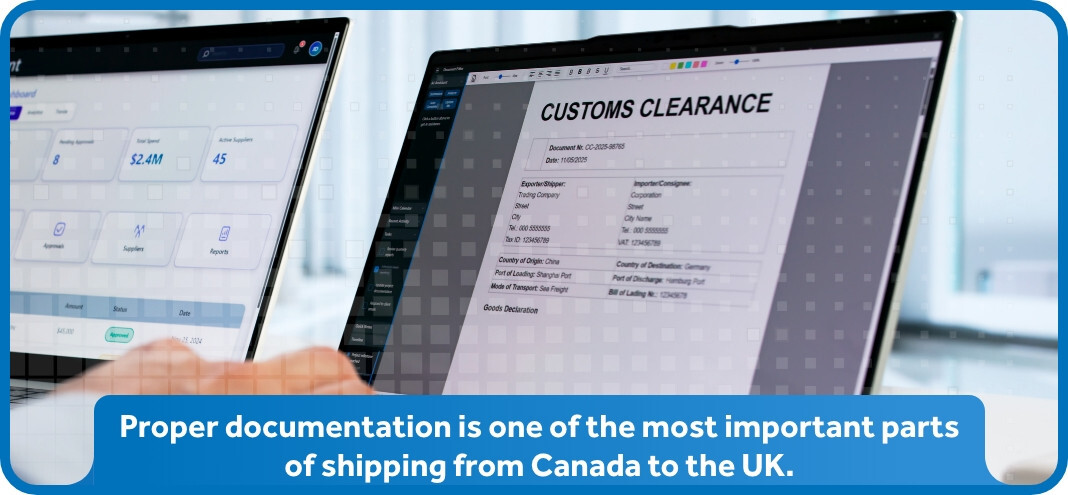
Proper documentation is one of the most important parts of shipping from Canada to the UK. Missing or incorrect paperwork can lead to delays, additional costs, or even shipment rejection at customs. For businesses, having the right documents prepared in advance ensures smooth and predictable delivery.
Key Documents for Canada to UK Shipping
Most shipments to the UK require the following core documents:
Commercial Invoice
This is the most important document for international shipping. It includes:
- Seller and buyer information
- Description of goods
- Quantity and value of items
- Country of origin
Customs authorities use the commercial invoice to assess duties and taxes.
Air Waybill (AWB) or Shipping Label
The Air Waybill acts as the shipping contract and contains:
- Shipment details
- Origin and destination
- Carrier information
It is essential for tracking and handling the shipment throughout transit.
Packing List
A packing list provides detailed information about the shipment contents, including:
- Number of packages
- Weight and dimensions
- Item breakdown
This helps customs and carriers verify the shipment.
HS Code (Harmonized System Code)
HS codes classify goods for international trade. They are used to:
- Determine applicable duties and taxes
- Ensure proper customs processing
Using the correct HS code is critical to avoid delays or penalties.
Additional Documents (When Required)
Depending on the type of goods, additional documentation may be needed:
- Certificate of origin
- Import/export permits
- Product-specific certifications (e.g., for food, health, or electronics)
Businesses shipping specialized or regulated products should verify requirements in advance.
Common Documentation Mistakes to Avoid
Many shipping delays are caused by simple documentation errors, such as:
- Incorrect or incomplete product descriptions
- Missing HS codes
- Declared values that do not match shipment contents
- Inconsistent information across documents
Ensuring accuracy and consistency across all paperwork is essential.
How Freightcom Simplifies Documentation
Freightcom helps businesses manage shipping documents by offering:
- Automated document generation
- Guided input for required fields
- Integrated shipping workflows
This reduces manual errors and helps ensure that shipments are properly prepared for customs clearance.
Accurate documentation not only speeds up delivery but also helps businesses avoid unnecessary costs and disruptions when shipping to the UK.
Customs Clearance Process in the UK
Customs clearance is a critical step when shipping from Canada to the UK. Every shipment entering the UK must go through customs to verify documentation, assess duties and taxes, and ensure compliance with import regulations. Understanding this process helps businesses avoid delays and maintain smooth delivery operations.
How Customs Clearance Works
When a shipment arrives in the UK, it goes through a structured process:
- Document Review
Customs authorities review key documents such as the commercial invoice, packing list, and shipping details.
- Goods Classification
Items are classified using HS codes to determine applicable duties and taxes. - Duties and VAT Assessment
Based on the shipment value and classification, customs calculates import duties and VAT. - Inspection (if required)
Some shipments may be inspected to verify contents and compliance. - Release for Delivery
Once cleared, the shipment is released for final delivery to the destination.
Common Reasons for Customs Delays
Delays during customs clearance are often caused by:
- Incomplete or incorrect documentation
- Incorrect HS codes
- Undervalued or mismatched shipment declarations
- Missing permits for regulated goods
Even small errors can result in significant delays, so accuracy is essential.
Duties and Taxes Payment Options
Businesses typically choose between two main options for handling duties and taxes:
- Delivered Duty Paid (DDP):
The sender covers all duties and taxes upfront, providing a smoother delivery experience for the customer. - Delivered Duty Unpaid (DDU):
The receiver is responsible for paying duties and taxes upon delivery, which may cause delays or additional handling.
Choosing the right option depends on your business model and customer expectations.
Tips for Faster Customs Clearance
To ensure faster processing, businesses should:
- Provide clear and accurate product descriptions
- Use correct HS codes
- Declare the true value of goods
- Prepare all required documents in advance
Consistency across all documents is key to avoiding unnecessary issues.
How Freightcom Helps with Customs Clearance
Freightcom simplifies the customs process by offering:
- Integrated documentation tools
- Guidance on required shipping information
- Access to carriers experienced in international shipping
- Support for managing duties and taxes
This helps businesses reduce delays and improve overall shipping efficiency when sending goods to the UK.
A well-managed customs process ensures that shipments move quickly through the border and reach customers without disruption.
Customs clearance can impact your delivery time if not handled properly. Ensuring accurate documentation and using reliable shipping solutions helps your shipments move smoothly through UK customs without delays.

Duties, Taxes and VAT When Shipping to the UK
When shipping from Canada to the UK, understanding duties, taxes, and VAT is essential for accurate pricing and a smooth delivery experience. These charges can significantly impact the total cost of shipping, especially for businesses selling products to customers in the UK.
What Are Duties and Taxes?
Import duties and taxes are fees imposed by the UK government on goods entering the country. These charges are based on:
- The type of product (HS code classification)
- The declared value of the goods
- The country of origin
Not all shipments are subject to the same rates, which is why proper classification and valuation are important.
Understanding VAT in the UK
VAT (Value Added Tax) is one of the main charges applied to imported goods in the UK. It is typically calculated based on:
- The value of the goods
- Shipping costs
- Applicable duties
VAT rates can vary depending on the type of product, but it is a standard part of most shipments entering the UK.
When Do Duties Apply?
Duties may apply depending on:
- The product category
- The declared value
- Trade agreements between countries
Some goods may have reduced or zero duty rates, while others may be subject to higher import charges.
Who Pays Duties and Taxes?
Businesses must decide how duties and taxes will be handled:
- Sender pays (DDP – Delivered Duty Paid):
The business covers all charges upfront, providing a seamless experience for the customer. - Receiver pays (DDU – Delivered Duty Unpaid):
The customer is responsible for paying duties and taxes upon delivery, which may lead to delays or refused shipments.
For eCommerce businesses, DDP is often preferred because it improves customer satisfaction and avoids unexpected charges.
How Duties and Taxes Impact Your Business
If not managed properly, duties and taxes can:
- Reduce profit margins
- Cause delivery delays
- Lead to poor customer experience
Accurate pricing and clear communication with customers are essential when selling internationally.
Tips to Manage Duties and Taxes Effectively
Businesses can better manage these costs by:
- Using correct HS codes for all products
- Declaring accurate shipment values
- Choosing the right duty payment method (DDP vs DDU)
- Including duties and taxes in product pricing when possible
These steps help avoid surprises and improve overall shipping efficiency.
How Freightcom Helps with Duties and Taxes
Freightcom supports businesses by offering:
- Clear visibility into shipping costs
- Tools to help manage duties and taxes
- Access to carriers experienced in international shipping
This allows businesses to plan ahead and provide a smoother delivery experience for customers in the UK.
Understanding duties, taxes, and VAT is key to building a reliable and transparent shipping strategy from Canada to the UK.
Shipping for eCommerce Businesses to the UK

Shipping from Canada to the UK presents a major growth opportunity for eCommerce businesses. With strong consumer demand and a well-developed online shopping market, the UK is one of the most attractive international destinations for Canadian online retailers.
Why the UK Is Important for eCommerce Expansion
The UK has a large and mature eCommerce market with customers who expect:
- Fast and reliable delivery
- Transparent shipping costs
- Real-time tracking
For Canadian businesses, this means having a shipping strategy that supports both speed and consistency is essential to compete effectively.
Common Products Shipped to the UK
eCommerce businesses frequently ship products such as:
- Jewelry and fashion accessories
- Clothing and apparel
- Electronics and gadgets
- Health and beauty products
- Home and lifestyle items
These products often require efficient handling and fast delivery to meet customer expectations.
Key Challenges for eCommerce Shipping
Shipping internationally comes with several challenges for online sellers:
- High shipping costs impacting margins
- Unclear duties and taxes for customers
- Delays at customs
- Managing multiple carriers and shipping options
Without the right system in place, these challenges can affect both operations and customer experience.
What eCommerce Businesses Need
To succeed in the UK market, eCommerce businesses need:
- Accurate shipping rates at checkout
- Reliable and fast delivery options
- Clear duties and tax handling
- Easy order fulfillment and tracking
Providing a smooth post-purchase experience is just as important as acquiring customers.
Optimizing the Customer Experience
A strong shipping strategy can improve conversion and retention by:
- Offering multiple delivery options (standard and express)
- Providing estimated delivery times upfront
- Reducing unexpected costs at delivery
- Enabling real-time tracking for customers
These factors build trust and encourage repeat purchases.
How Freightcom Supports eCommerce Shipping
Freightcom helps eCommerce businesses streamline their shipping operations by offering:
- Real-time shipping rates at checkout
- Multi-carrier access for flexible delivery options
- Automated shipping workflows
- Scalable solutions for growing order volumes
This allows businesses to expand into the UK market with confidence while maintaining efficient and reliable shipping operations.
Shipping is a key part of the eCommerce customer experience, and optimizing it can directly impact business growth when expanding from Canada to the UK.
Take your eCommerce business global by offering fast, reliable, and cost-effective shipping to the UK. Simplify your fulfillment process and deliver a better experience to your customers.
Shipping for Small Businesses from Canada to UK
For small businesses, shipping from Canada to the UK can open the door to new markets, broader customer reach, and increased revenue opportunities. However, success in international shipping requires a well-planned approach to manage costs, delivery timelines, and operational efficiency.
Why the UK Market Is Valuable for Small Businesses
The UK is a highly developed and diverse market with strong demand across a wide range of industries. Businesses from different sectors can successfully ship products such as:
- Consumer goods and retail products
- eCommerce and online store items
- Industrial and commercial equipment
- Automotive parts and components
- Electronics and technology products
- Health, wellness, and personal care items
- Home goods and lifestyle products
- Printed materials and custom products
This wide demand makes the UK an attractive destination for small businesses looking to expand internationally, regardless of their industry.
In addition, UK customers are accustomed to ordering from international sellers, which creates opportunities for Canadian businesses to compete globally. With the right shipping strategy in place, small businesses can enter the UK market with confidence and scale their operations over time.
Common Challenges Small Businesses Face
Small businesses often encounter challenges when shipping internationally, including:
- Higher shipping costs due to lower volume
- Limited access to discounted carrier rates
- Managing customs documentation and regulations
- Balancing cost and delivery speed
Without the right tools, these challenges can limit growth and profitability.
What Small Businesses Need to Succeed
To effectively ship to the UK, small businesses need:
- Affordable and flexible shipping options
- Clear pricing with no hidden fees
- Reliable delivery timelines
- Simple shipping and order management
Having access to scalable solutions is important as order volume increases.
Cost Control and Flexibility
Managing shipping costs is critical for small businesses. This can be achieved by:
- Comparing rates across multiple carriers
- Choosing the right shipping speed for each order
- Optimizing packaging to reduce dimensional weight
- Planning shipments efficiently
These strategies help maintain healthy margins while staying competitive.
Building a Scalable Shipping Process
As small businesses grow, their shipping needs become more complex. A scalable process should include:
- Centralized shipment management
- Automated workflows for order fulfillment
- Access to multiple carriers
- Consistent tracking and delivery updates
This ensures operations remain efficient as the business expands.
How Freightcom Supports Small Businesses
Freightcom provides small businesses with tools that simplify international shipping, including:
- Discounted shipping rates typically available to larger businesses
- Multi-carrier options for flexibility
- Easy-to-use shipping platform
- Scalable solutions that grow with your business
This allows small businesses to compete with larger companies while maintaining control over costs and operations.
Shipping to the UK can be a powerful growth opportunity for small businesses when supported by the right strategy and tools.

Express Shipping Options from Canada to UK
For businesses that prioritize speed and reliability, express shipping is one of the most effective ways to deliver goods from Canada to the UK. It is especially valuable for time-sensitive shipments, high-value products, and customer-facing orders where delivery experience matters.
What Is Express Shipping?
Express shipping refers to fast, priority delivery services designed to minimize transit time. These services typically include:
- Short delivery windows (often within a few days)
- Priority handling throughout the shipping process
- Faster customs processing
- End-to-end tracking
This makes express shipping a preferred option for businesses that need consistent and predictable delivery performance.
When to Use Express Shipping
Express shipping is ideal in scenarios such as:
- Urgent customer orders
- Low inventory situations requiring fast restocking
- Shipping high-value or fragile goods
- Meeting strict delivery deadlines
Businesses often use express shipping to maintain service levels and avoid disruptions in their supply chain.
Benefits of Express Shipping
Using express shipping from Canada to the UK provides several advantages:
- Faster delivery times improve customer satisfaction
- Reliable transit schedules reduce uncertainty
- Better tracking visibility allows real-time shipment monitoring
- Reduced risk of delays compared to slower methods
These benefits are especially important for eCommerce and time-sensitive industries.
Cost Considerations
While express shipping offers speed and reliability, it typically comes at a higher cost. Businesses should consider:
- The value of the goods being shipped
- Customer expectations for delivery speed
- The impact of delays on operations
In many cases, the higher cost is justified by improved customer experience and faster cash flow cycles.
Balancing Speed and Cost
Not every shipment needs express delivery. Businesses can optimize their strategy by:
- Using express shipping for urgent or high-priority orders
- Choosing standard options for less time-sensitive shipments
- Offering multiple delivery options to customers at checkout
This approach helps balance operational efficiency with cost control.
How Freightcom Supports Express Shipping
Freightcom enables businesses to access and manage express shipping options by offering:
- Multiple carrier choices for fast delivery
- Real-time rate comparisons
- Flexible shipping options based on urgency
- Centralized tracking and shipment management
This allows businesses to choose the best express solution without overpaying or adding complexity.
Express shipping plays a key role in maintaining speed, reliability, and customer satisfaction when shipping from Canada to the UK.
How to Reduce Shipping Costs from Canada to UK
Reducing shipping costs from Canada to the UK is essential for maintaining healthy profit margins, especially for businesses handling frequent or high-volume shipments. With the right strategies, businesses can significantly lower expenses without compromising delivery performance.
Optimize Packaging Efficiency
Packaging plays a major role in shipping costs, especially when carriers use dimensional weight for pricing. Businesses can reduce costs by:
- Using smaller, right-sized packaging
- Avoiding unnecessary empty space
- Choosing lightweight but durable materials
Efficient packaging helps minimize chargeable weight and lowers overall shipping rates.
Compare Multiple Carrier Rates
Shipping rates can vary widely between carriers. Businesses that compare options can:
- Find the most cost-effective shipping method
- Balance speed and pricing
- Avoid overpaying for similar services
Using a platform that provides real-time rate comparisons can make this process much easier.
Choose the Right Shipping Speed
Not every shipment requires the fastest delivery option. Businesses can reduce costs by:
- Using express shipping only for urgent orders
- Selecting standard options for regular deliveries
- Aligning delivery speed with customer expectations
This approach helps control costs while maintaining service quality.
Consolidate Shipments
Combining multiple shipments into one can reduce per-unit shipping costs. This is especially useful for:
- Bulk orders
- Regular shipments to the same destination
- Inventory restocking
Consolidation helps businesses take advantage of better pricing for larger shipments.
Plan Ahead and Avoid Peak Costs
Shipping rates can increase during peak seasons due to higher demand. Businesses can reduce costs by:
- Planning shipments in advance
- Avoiding last-minute or urgent shipments when possible
- Managing inventory to prevent rush orders
Proactive planning helps avoid premium pricing.
Leverage Discounted Shipping Rates
Access to discounted rates can make a significant difference in overall shipping costs. Businesses can benefit from:
- Negotiated carrier rates
- Volume-based discounts
- Long-term shipping partnerships
These savings can add up quickly over time.
How Freightcom Helps Reduce Shipping Costs
Freightcom provides tools and features that help businesses lower their shipping expenses, including:
- Discounted shipping rates across multiple carriers
- Real-time rate comparison
- Flexible shipping options based on budget and urgency
- Centralized shipment management
This allows businesses to optimize their shipping strategy while maintaining reliable delivery performance.
Reducing shipping costs is not about cutting corners, it is about making smarter decisions that improve efficiency and profitability.
Shipping costs can quickly add up, but using the right tools and strategies helps you stay in control. Accessing real-time rates and choosing the best option for each shipment can improve efficiency and protect your margins.

Packaging Tips for International Shipping to the UK

Proper packaging is essential when shipping from Canada to the UK. It not only protects your products during transit but also helps control shipping costs and ensures smooth handling throughout the delivery process.
Why Packaging Matters in International Shipping
International shipments go through multiple stages, including handling, sorting, transportation, and customs inspection. Poor packaging can lead to:
- Product damage
- Delays in transit
- Additional charges due to repacking
- Negative customer experience
Using the right packaging approach helps businesses avoid these risks.
Choose the Right Box Size and Material
Selecting appropriate packaging is one of the most effective ways to optimize shipping:
- Use strong, durable boxes suitable for international transit
- Choose the correct box size to reduce empty space
- Avoid oversized packaging that increases dimensional weight
Right-sized packaging directly impacts both cost and product safety.
Protect Products Properly
Proper internal protection is just as important as the outer box. Businesses should:
- Use cushioning materials such as bubble wrap or foam
- Secure items to prevent movement in the box
- Add extra protection for fragile items
This reduces the risk of damage during long-distance shipping.
Labeling and Documentation Placement
Clear and accurate labeling ensures smooth handling and delivery:
- Attach shipping labels securely and visibly
- Include all required documentation
- Ensure consistency between package labels and documents
Incorrect or unclear labeling can lead to delays or misrouting.
Consider Weight and Cost Optimization
Packaging directly affects shipping costs. Businesses can reduce expenses by:
- Using lightweight materials where possible
- Avoiding unnecessary packaging layers
- Designing packaging that fits product dimensions closely
Even small improvements in packaging can result in noticeable cost savings.
Prepare for Customs and Inspections
Packages may be opened during customs inspection. To avoid issues:
- Pack items neatly and logically
- Ensure contents match documentation
- Avoid overpacking or disorganized packaging
This helps speed up customs clearance and reduces handling issues.
How Freightcom Helps Optimize Packaging
Freightcom supports businesses by helping them:
- Choose cost-effective shipping options based on package size and weight
- Compare rates to understand packaging impact on pricing
- Optimize shipments through better planning and packaging strategies
This enables businesses to improve both efficiency and cost control.
Effective packaging is a key part of a successful shipping strategy, helping businesses protect products, reduce costs, and deliver a better customer experience.
How Freightcom Helps Businesses Ship to the UK
Shipping from Canada to the UK can become complex as businesses grow, especially when managing multiple carriers, fluctuating rates, and international requirements. Using a centralized shipping platform like Freightcom helps simplify operations while improving efficiency and cost control.
Centralized Shipping Management
Freightcom provides a single platform where businesses can manage all their shipments. This includes:
- Creating and managing shipments in one place
- Accessing multiple carriers without switching between systems
- Tracking all shipments from a centralized dashboard
This reduces operational complexity and saves time.
Real-Time Rate Comparison
One of the biggest advantages of Freightcom is the ability to compare shipping rates in real time. Businesses can:
- View multiple carrier options instantly
- Choose the best balance between cost and speed
- Avoid overpaying for similar services
This transparency helps businesses make informed shipping decisions.
Access to Discounted Shipping Rates
Freightcom offers discounted rates that are typically available only to high-volume shippers. This allows businesses to:
- Reduce shipping costs
- Stay competitive in pricing
- Improve profit margins
These savings can make a significant difference, especially for growing businesses.
Multi-Carrier Flexibility
Different shipments require different solutions. Freightcom enables businesses to:
- Choose from multiple carriers for each shipment
- Adjust shipping methods based on urgency and cost
- Scale operations without being tied to one provider
This flexibility is essential for businesses shipping to multiple destinations across the UK.
Automation and Workflow Efficiency
Freightcom helps streamline operations through automation, including:
- Automated shipment creation
- Integrated workflows for order fulfillment
- Reduced manual data entry
This improves accuracy and allows teams to focus on higher-value tasks.
Scalable Solutions for Business Growth
As shipping volume increases, managing logistics can become more challenging. Freightcom supports scalability by offering:
- Solutions for both small and high-volume shipments
- Consistent performance across different regions
- Tools that grow with your business needs
This ensures businesses can expand into the UK market without operational bottlenecks.
Supporting a Better Customer Experience
By improving shipping efficiency, Freightcom helps businesses deliver a better customer experience through:
- Faster and more reliable delivery
- Clear shipping options at checkout
- Accurate tracking and updates
This leads to higher customer satisfaction and stronger retention.
Using Freightcom allows businesses to simplify international shipping, reduce costs, and build a more efficient logistics strategy when shipping from Canada to the UK.
FAQs About Shipping from Canada to the UK
Below are the most important and commonly searched questions about shipping from Canada to the UK. These FAQs are structured to be SEO-friendly, AI-readable, and focused on high-value commercial intent.
1. How much does shipping from Canada to the UK cost?
Shipping costs depend on weight, dimensions, delivery speed, and destination. Businesses can reduce costs by comparing carrier rates, optimizing packaging, and choosing the right shipping option based on urgency.
2. Can I get instant shipping rates from Canada to the UK?
Yes, you can get instant shipping rates from Canada to the UK by using a shipping platform like Freightcom. Simply enter your shipment details to compare real-time carrier rates, delivery speeds, and options in one place, helping you choose the most cost-effective solution quickly and efficiently.
3. What is the fastest shipping option from Canada to the UK?
The fastest options are express and priority shipping services, which offer short transit times and reliable delivery schedules. These are ideal for urgent or high-value shipments.
4. Do I have to pay duties and taxes when shipping to the UK?
Yes, most shipments are subject to import duties and VAT. These charges depend on the product type, value, and classification. Businesses can choose whether the sender or receiver pays these fees.
5. Who pays duties and taxes when shipping to the UK?
Duties and taxes can be paid by:
- The sender (DDP – Delivered Duty Paid)
- The receiver (DDU – Delivered Duty Unpaid)
DDP is often preferred for eCommerce as it improves customer experience and avoids unexpected charges.
6. What documents are required for shipping from Canada to the UK?
Typical documents include:
- Commercial invoice
- Shipping label or air waybill
- Packing list
- HS code for product classification
- More items ....
Accurate documentation is essential to avoid delays.
7. How can I reduce shipping costs from Canada to the UK?
Businesses can reduce costs by:
- Comparing multiple carriers
- Optimizing packaging
- Choosing appropriate shipping speeds
- Consolidating shipments
Using a shipping platform can also provide access to discounted rates.
8. What items can I ship from Canada to the UK?
Most commercial goods can be shipped, including apparel, electronics, and consumer products. However, some items may be restricted or require special permits.
9. What causes delays in shipping to the UK?
Common causes of delays include:
- Incorrect or missing documentation
- Customs inspections
- Incorrect HS codes
- Peak shipping periods
Proper preparation helps minimize delays.
10. How do I choose the right shipping carrier?
The right carrier depends on:
- Shipping speed requirements
- Budget
- Shipment size and type
Comparing multiple carriers helps businesses find the best option.
Final Thoughts and Start Shipping from Canada to the UK with Confidence
Shipping from Canada to the UK can be simple, cost-effective, and scalable when you have the right strategy and tools in place. From understanding shipping costs and transit times to managing customs, documentation, and delivery expectations, every step plays a role in building a reliable international shipping process.
For businesses, the goal is not just to ship products, it is to deliver a consistent experience, control costs, and scale operations efficiently. Whether you are an eCommerce brand, a small business, or a growing company, having access to the right shipping solutions can make a significant difference in your success in the UK market.
Freightcom helps you streamline your entire shipping process by giving you:
- Real-time rate comparisons across multiple carriers
- Discounted shipping rates to reduce costs
- Flexible shipping options based on your business needs
- Automated tools to simplify operations and save time
Ready to simplify your shipping from Canada to the UK?
Start using Freightcom today and discover how easy it is to compare rates, manage shipments, and grow your business with a smarter shipping solution.

.png?width=250&height=58&name=MicrosoftTeams-image%20(28).png "Freightcom")


