
When it comes to shipping, selecting the right vehicle for your goods is more than just a preference; it’s a critical decision that impacts cost, security, and delivery speed. Whether you’re moving a few pallets with LTL (Less-Than-Truckload) or require a dedicated FTL (Full-Truckload) service, knowing the difference between a Dry Van and a Reefer, or when to opt for a Flatbed, can significantly optimize your supply chain.
At Freightcom, we know that every shipment is unique. That’s why we’ve compiled this essential guide to the most common truck and trailer types, detailing their specifications and the ideal shipping scenarios for each. Use this guide to empower your shipping choices and ensure your cargo is transported safely and efficiently every time.
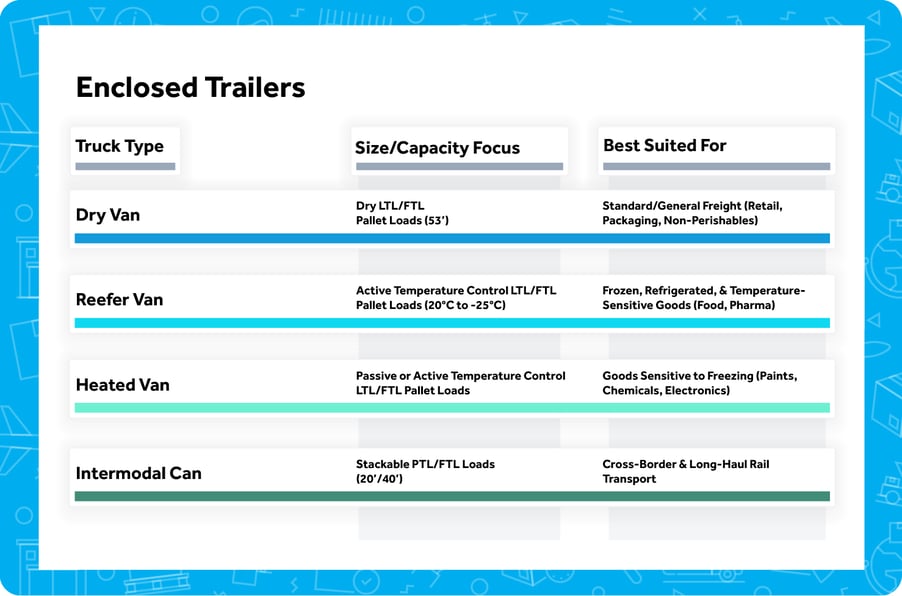
Group 1: Standard Enclosed Trailers (Van & Container Freight)
These vehicles are the backbone of the freight industry, offering protection from the elements and high capacity. They are best suited for general freight that fits within standard dimensions.
Dry Van Trailers
- Vehicle Types:
- DRY VAN - 53’ TRAILER: The most common trailer on the road.
- Ideal Situation: The default choice for the vast majority of FTL and LTL shipments. Use for non-perishable goods, retail products, building materials, and packaged foods that do not require temperature control. It offers maximum protection against weather, theft, and road grime.
- Key Advantage: Versatility and wide availability, leading to the most competitive freight shipping rates.
Temperature-Controlled Vans
When cargo needs consistent temperature regulation, either warm or cold, specialized vans are required.
- Vehicle Types:
- HEATED VAN – 53’ TRAILER
- REEFER VAN – 53’ TRAILER (Reefer is short for Refrigerated)
- Ideal Situation:
- Heated Vans are crucial in winter months for sensitive, non-perishable goods (like certain chemicals, paints, electronics, or food items) that must be protected from freezing.
- Reefer Vans are used for frozen, refrigerated, or chilled goods, including produce, meats, pharmaceuticals, and temperature-sensitive chemicals.
- Key Advantage: Maintaining product integrity and extending the shelf-life of perishable or sensitive goods across long distances.
- Intermodal Containers (Cans)
Intermodal transport seamlessly moves cargo between ship, rail, and road using standardized containers, significantly boosting supply chain efficiency.
- Vehicle Types:
- INTERMODAL CONTAINERS – 40’ CAN
- HEATED CAN – 40’
- REEFER CAN – 40’
- DRY CAN – 20’
- Ideal Situation: Cross-border shipping, long-haul domestic rail transport, and international trade. They are robust, stackable, and simplify transfer between transport modes. The 20’ Dry Can is often used for heavier cargo due to better weight distribution limits.
- Key Advantage: Cost-effective for long-distance transit; minimizes handling and risk by keeping cargo sealed from the point of origin to the destination.
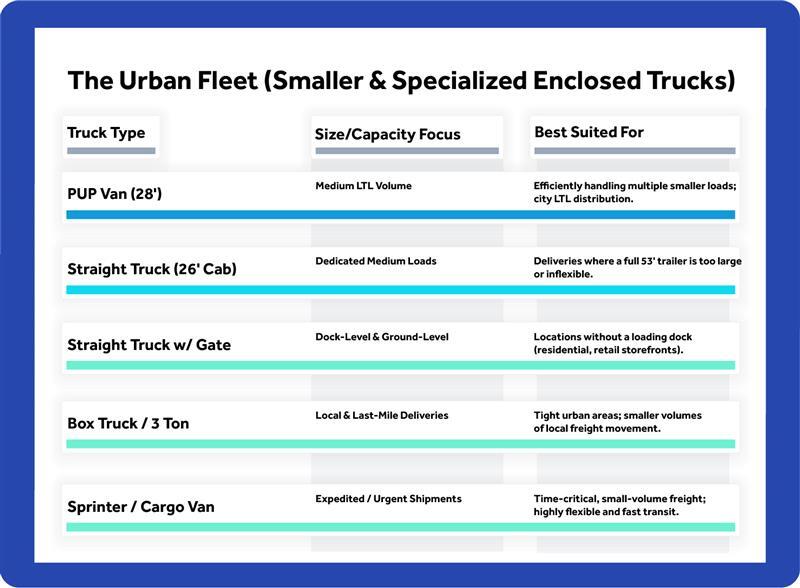
Group 2: Smaller & Specialized Enclosed Trucks
These vehicles are designed for flexibility, urban deliveries, and locations where a large 53’ trailer cannot easily access.
Dedicated Delivery Trucks
These vehicles are the workhorses of local, urban, and specific customer deliveries, offering greater maneuverability than a full tractor-trailer.
- Vehicle Types:
- PUP VANS – 28’ TRAILER: A smaller trailer, often used in LTL to handle multiple smaller loads or in "doubles" configurations.
- STRAIGHT TRUCK – 26’ CAB: A single-unit truck where the cab and cargo area are one piece.
- STRAIGHT TRUCK – 26’ CAB WITH TAILGATE / RAILGATE: A single unit truck that includes a hydraulic lift (tailgate or railgate) for easier loading/unloading at locations without a dock.
- STRAIGHT TRUCK – 3 TON: A medium-duty truck, often used for smaller local LTL shipments, challenging-to-navigate deliveries such as urban areas, or dedicated last-mile deliveries.
- BOX TRUCK: A generic term, usually referring to a Straight Truck.
- Ideal Situation: LTL distribution, residential deliveries, deliveries to retail storefronts in crowded city centres, or locations with limited docking facilities. The liftgate option is indispensable for ground-level loading and unloading.
- Key Advantage: Superior access and maneuverability for "final mile" logistics and city driving.
Small Package/Expedited Vehicles
These are the smallest commercial vehicles, perfect for time-sensitive, low-volume, or smaller parcel freight movements.
- Vehicle Types:
- SPRINTER VAN: A tall, mid-sized van with higher cubic capacity than a standard van.
- CARGO VAN: A standard, small delivery van.
- Ideal Situation: Expedited shipping, highly urgent small shipments, same-day delivery, and moving less-than-a-pallet amounts of freight.
- Key Advantage: Speed, minimum size requirement, and door-to-door service for time-critical parts or documents.
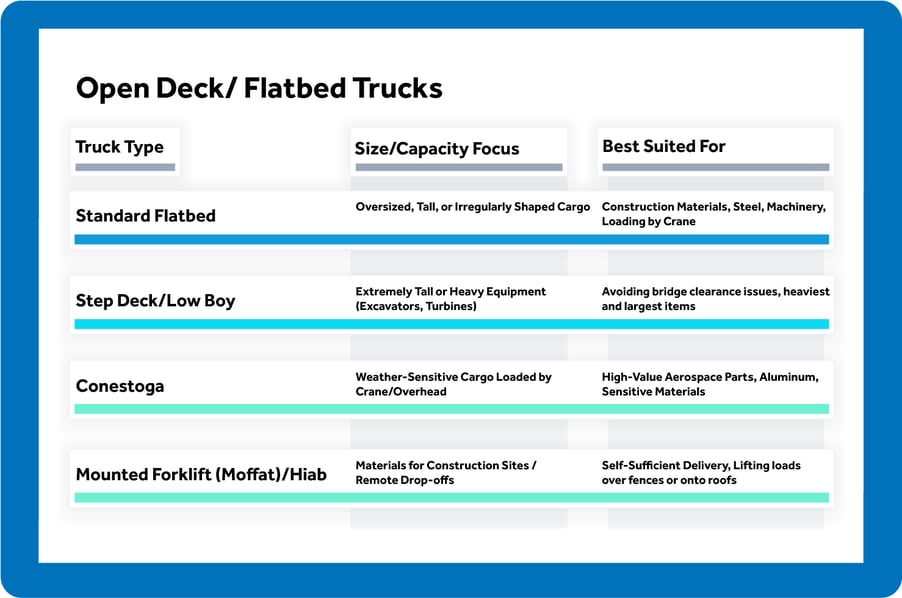
Group 3: Open Deck and Specialized Flatbed Transport
When cargo is too wide, too tall, irregularly shaped, or requires specialized handling equipment, Flatbed shipping is the answer.
Standard & Specialized Flatbeds
These trailers provide an open deck for easy side or top loading and accommodate oversized freight.
- Vehicle Types:
- FLATBED – 53’ DECK: The standard open deck trailer.
- FLATBED – STEP DECK: Has a drop-down deck section, allowing taller cargo than a standard flatbed while staying under bridge clearance limits.
- FLATBED – LOW BOY: Features the lowest deck height of all, designed specifically for super-heavy, over-height equipment (e.g., construction machinery, massive industrial components).
- Ideal Situation: Transporting machinery, large industrial equipment, construction materials, steel, lumber, and any cargo that must be loaded by an overhead crane or requires a height clearance exceeding a standard van.
- Key Advantage: Capacity for oversized and irregularly shaped freight that cannot be contained within an enclosed trailer.
Covered Flatbeds
Offering the loading flexibility of a flatbed with the weather protection of a van.
- Vehicle Types:
- FLATBED – CONESTOGA
- Ideal Situation: Ideal for freight that is sensitive to weather but requires crane loading, such as high-value pre-fabricated components, aluminum, or aerospace parts. The tarp system rolls back to expose the deck for loading and then rolls shut for protection.
- Key Advantage: Combines the convenience of overhead loading with the necessary protection from the elements.
Flatbeds with On-Site Handling Equipment
These trucks come equipped with their own machinery, making them self-sufficient for loading and unloading at sites without docks or specialized equipment.
- Vehicle Types:
- FLATBED – TRUCK MOUNTED FORKLIFT/MOFFETT: (53’ trailer with a forklift attached to the rear)
- FLATBED – 5 TON / 26’: A smaller flatbed truck.
- FLATBED – 5 TON TRUCK MOUNTED FORKLIFT: (Smaller 5-ton flatbed with a forklift attached)
- FLATBED – 5 TON TRUCK MOUNTED CRANE/HIAB: (Smaller flatbed with a crane attachment)
- Ideal Situation: Delivering to construction sites, remote locations, residential areas, or anywhere ground-level material handling is needed. The Mounted Forklift is perfect for dropping materials right where they are needed. The Crane/HIAB truck is essential for lifting heavy, awkward loads over obstacles or onto elevated platforms.
- Key Advantage: Eliminates the need for external forklifts or cranes at the delivery point, saving time and money for the customer.
4. Hotshot / Gooseneck Service
A specialized, expedited service for urgent, smaller flatbed freight.
- Vehicle Types:
- FLATBED – 1 TON HOTSHOT / GOOSENECK TRAILER: A heavy-duty pickup truck pulling a specialized trailer.
- Ideal Situation: High-priority, time-critical, smaller loads (often less than 10,000 lbs) that need to move fast and don't require a full FTL flatbed. This is a common solution for parts and specialized equipment.
- Key Advantage: Extreme speed and flexibility; able to bypass some weigh stations and rest stops, leading to faster transit times for urgent freight.
Pick the Right Service at the Right Price Every Time with Freightcom
Understanding your freight shipping options is the first step toward a more efficient and cost-effective supply chain. Whether your next shipment calls for the simplicity of a Dry Van, the precision of a Reefer, or the self-sufficiency of a Mounted Forklift Flatbed, Freightcom provides you with the competitive rates and expert advice you need.
Our all-in-one platform and dedicated support team can match your shipment's unique requirements with the perfect vehicle, ensuring secure, timely, and cost-effective delivery every time.
Contact one of our shipping experts today and see how Freightcom can help you find the right shipping for your business every time.



.png?width=250&height=58&name=MicrosoftTeams-image%20(28).png "Freightcom")


