




Introduction: The New Reality of Cross-Border Trade
For years, small and medium-sized businesses (SMBs) navigating the complexities of cross-border shipping between Canada and the United States have operated under a relatively reactive compliance framework. When exporting consumer goods to the US, maintaining a Certificate of Compliance, whether a Children’s Product Certificate (CPC) or a General Certificate of Conformity (GCC), was largely an administrative back-office task. Exporters were required to issue these documents and make them available upon request, but they rarely had to present them proactively at the border.
That reality changes permanently on July 8, 2026.
The United States Consumer Product Safety Commission (CPSC), in coordination with US Customs and Border Protection (CBP), is implementing a strict, mandatory electronic filing (eFiling) requirement for all regulated consumer product imports. Paper certificates and "available upon request" policies are officially ending. Under the newly revised 16 CFR Part 1110 framework, you or your customs broker must electronically submit specific product safety data elements directly into CBP’s Automated Commercial Environment (ACE) system at the very moment your customs entry is filed.
If you are a Canadian SMB, manufacturer, distributor, or wholesaler shipping direct-to-consumer freight across the border, this regulatory shift introduces unprecedented operational pressure. Compliance is no longer just a legal obligation; it is an absolute condition of border entry. This comprehensive guide will equip you with the strategic and technical knowledge required to restructure your supply chain documentation, partner effectively with your customs broker, and ensure your Less-Than-Truckload (LTL), Full-Truckload (FTL), and parcel shipping continues to cross the US border without costly interruptions.
Please note: the information provided in this guide is for general informational purposes only and does not constitute legal, tax, or customs advice. While we strive to ensure accuracy, we make no guarantees and assume no responsibility for any errors, omissions, or outcomes resulting from the use of this information. Customers are responsible for verifying requirements with the appropriate customs authorities or trade professionals before shipping.
| When shipping a parcel through the Freightcom system, new fields will appear to help guide you through CPSC compliance requirements if applicable. For LTL shipments, your broker will provide guidance on any applicable compliance requirements. |
Section 1: Demystifying the CPSC eFiling Mandate
To effectively prepare for the July 8 deadline, it is critical to understand why this shift is occurring and how the mechanism operates. The transition from voluntary pilot programs to full electronic enforcement is designed to modernize US border security and targeting capabilities. By collecting data elements in a standardized digital format, the CPSC can perform real-time automated risk assessments on inbound cargo before it even reaches a physical port of entry.
For your business, this means that customs clearance is transitioning from a document-review process to a data-governance process.
The technical bridge for this requirement is the Partner Government Agency (PGA) message set within the ACE system. When your freight arrives at the border or is processed for entry, the CBP system checks for specific Harmonized Tariff Schedule (HTS) codes that have been flagged by the CPSC. If your product matches an HTS code on the CPSC's tracking list, the ACE system will actively block the entry from clearing unless the mandatory compliance data fields are completed.
Crucial Compliance Note: While the CPSC maintains an official HTS guidance list to trigger automated flags, this list is not exhaustive. Exporters remain legally responsible for knowing whether their products are subject to CPSC safety standards. If your product is legally regulated but its HTS code does not trigger an automated flag, you are still required to ensure compliance.
Section 2: Is Your Shipment Affected? Regulated Products & Certification Types
The eFiling requirement applies universally to finished consumer products entering the United States that are subject to any CPSC safety rules, bans, standards, or regulations. It does not apply to raw materials or unfinished industrial components unless those components are being directly marketed to consumers as standalone products.
To determine your business's exposure, you must categorize your product portfolio into the two primary compliance branches:
1. Children’s Product Certificates (CPC)
Any product designed or intended primarily for children 12 years of age or younger requires a CPC. These products are subject to rigorous, mandatory third-party testing conducted by a CPSC-accepted laboratory.
2. General Certificates of Conformity (GCC)
General-use, non-children's products that are subject to specific consumer product safety rules (such as architectural glazing, bicycle helmets, mattresses, apparel textiles, and electronic systems) require a GCC. Unlike CPCs, GCCs can be supported either by third-party laboratory testing or by a reasonable testing program managed directly by the manufacturer.
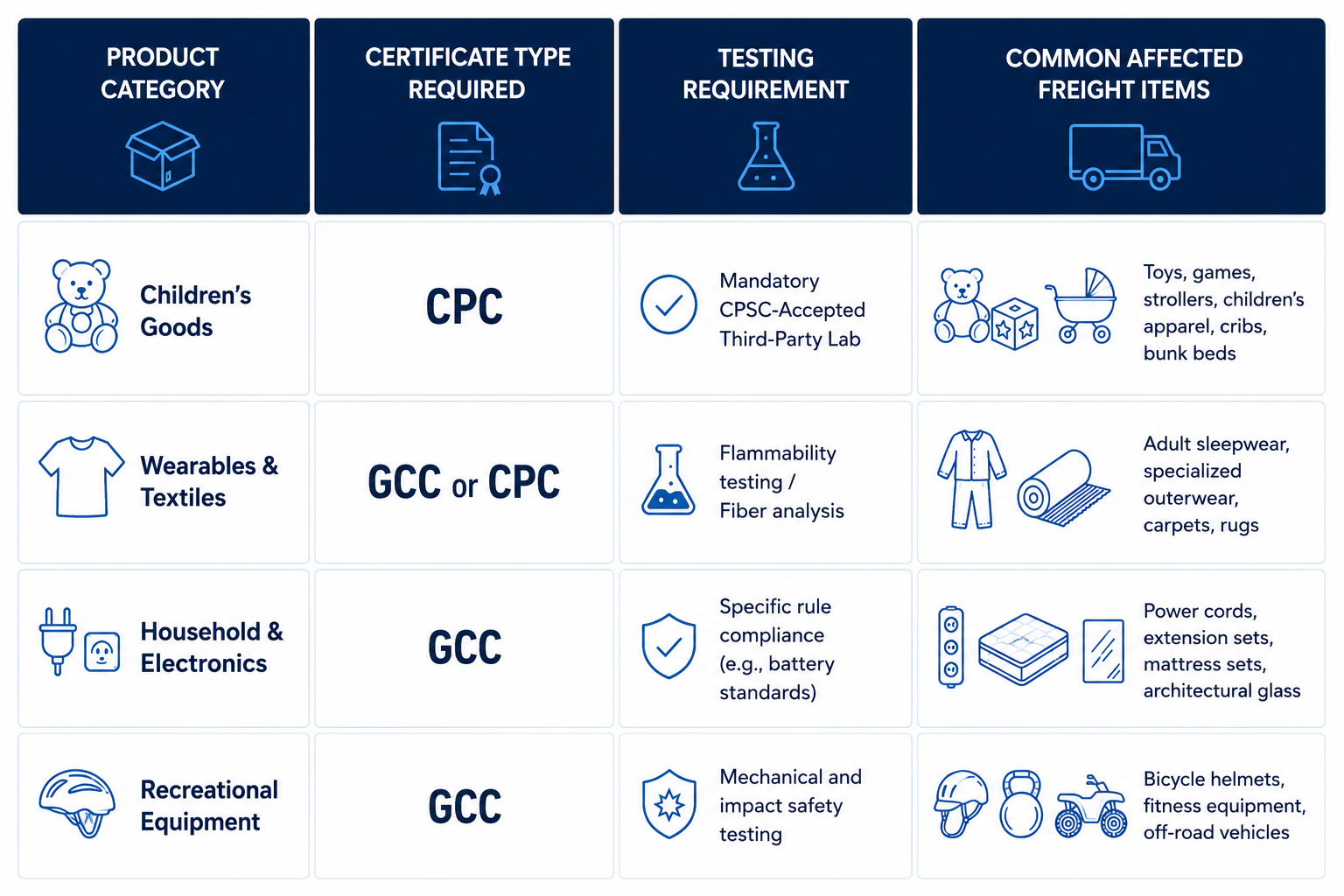
To help SMBs navigate this complex regulatory web, the CPSC provides an online interactive tool known as the Regulatory Robot. By answering a series of targeted questions regarding your product's material composition, intended user base, and functional design, the Regulatory Robot provides an excellent baseline report outlining the exact federal safety standards and testing rules your product must satisfy.
Section 3: The Technical Blueprint: The 7 Mandatory Data Elements
If your shipment contains regulated consumer products, you must provide a precise set of data elements before it ships. Under the Full PGA Message Set protocol, there are seven mandatory fields that must be electronically filed for every single shipment:
- Product Identifier: You must provide a highly specific, unique alphanumeric identifier for the finished product. The CPSC officially accepts seven specific format types: Global Trade Item Number (GTIN), Stock Keeping Unit (SKU), Universal Product Code (UPC), Model Number, Serial Number, Registered Number, or an approved Alternate ID.
- Applicable Safety Rules: A comprehensive list of the specific CPSC safety citations, rules, bans, or standards to which the product is being certified (e.g., 16 CFR Part 1303 for lead-containing paint).
- Date and Place of Manufacture: The exact month and year when the final product was manufactured, along with the precise geographic location (city, state/province, and country) of the manufacturing facility.
- Date and Place of Testing: The specific date (or date range) when the product was tested for compliance, alongside the geographic location of the testing facility.
- Testing Laboratory Information: The legal name, full mailing address, email address, and phone number of the laboratory that executed the safety tests. Under the revised 16 CFR Part 1110 rule, you must also explicitly declare any specific testing exclusions you are relying upon.
- Records Custodian Contact Information: The full name, physical mailing address, email address, and telephone number of the specific individual within your organization who maintains the underlying raw test reports and compliance records.
- Certifying Party Information: The business name, address, and contact information of the importer of record or domestic manufacturer who is formally attesting to the product's compliance.
Section 4: Choosing Your Compliance Pathway
Managing seven highly detailed data fields for every single item inside a complex, multi-SKU freight or parcel shipment can quickly lead to operational gridlock. To alleviate this burden, the CPSC has established two distinct pathways for transmitting data into the ACE system:
Pathway A: Full Data Submission (Per-Shipment Filing)
In this model, you or your customs broker manually inputs all seven mandatory data elements into the PGA message set every time a new shipment is entered at the border. This method requires no upfront registration with the CPSC but places an immense administrative burden on your shipping team and customs broker prior to every dispatch. A single data entry error or missing laboratory phone number can trigger an immediate automated rejection at the border.
Pathway B: Product Registry & Reference Filing (Recommended)
For frequent cross-border freight shippers, the CPSC Product Registry is a far superior operational strategy. This secure online portal allows importers to pre-load and centralize all seven mandatory data elements for their entire product catalog directly into the CPSC database ahead of time.
Once your products are registered, the system generates a unique Certifier ID and Certificate Identifier. When it is time to ship your freight or parcels, you only need to input an abbreviated Reference PGA Message Set containing just three fields:
- The unique Product ID
- The pre-registered Certifier ID
- The specific Certificate Identifier
The ACE system automatically pulls the rest of the verified data from the registry. This drastically minimizes data entry errors, simplifies documentation, and accelerates the customs clearance process.
Section 5: The Cost of Complacency: Severe Downstream Impacts
The CPSC and CBP have made it clear that enforcement of the eFiling mandate will be strict from day one. Incomplete, missing, or inaccurate certificate data will immediately flag your shipment as high-risk, resulting in severe disruptions to your parcel or freight operations:
- Prolonged Shipment Holds: If an automated flag is triggered and data is missing, the CPSC can issue a physical hold on your parcel or freight cargo. CPSC border examinations routinely take days, and in complex cases, cargo can be detained for up to 60 days.
- Escalating LTL & FTL Fees: Unlike small parcel shipments, freight cargo cannot sit indefinitely at a port of entry without incurring astronomical fees. You will be held financially responsible for all associated storage, demurrage, cargo manipulation, and bonded warehousing costs while your shipment is stuck in limbo.
- Elevated Importer Risk Scores: Every compliance failure directly degrades your business's permanent risk profile with US customs. A higher risk score means your future shipments will be subjected to significantly more frequent audits, physical exams, and systematic delays.
- Severe Legal and Financial Penalties: Beyond logistics delays, presenting false, inaccurate, or incomplete compliance statements to US officials can result in severe civil or criminal monetary penalties, product seizures, or mandatory recalls.
Section 6: Actionable Readiness Roadmap for Freightcom Shippers
With the July 8 deadline fast approaching, Canadian SMBs must treat data readiness as an immediate operational priority. Use the following checklist to align your freight supply chain before enforcement begins:
Step 1: Audit Your Current Catalog
Review your entire product inventory with the Regulatory Robot to isolate every single item that requires a CPC or GCC.
Step 2: Engage Upstream Suppliers
Reach out to your manufacturers and suppliers immediately. Request standardized digital access to verified manufacturing dates, facility locations, and test reports. Use this information to compile your own centralized internal compliance database.
Step 3: Establish Your CPSC Product Registry Account
If you ship recurring product lines, do not wait for the deadline. Build your registry account and register your products now to begin pre-loading your certificate data to secure your Certifier IDs.
Step 4: Coordinate with Your Customs Broker
For LTL shipments, your broker cannot guess your compliance data, nor are they legally allowed to certify products on your behalf. Establish strict data transmission protocols with your broker well before your trucks head to the border. Enter applicable information when shipping parcels on the Freightcom system. New fields will appear to ensure your shipment is compliant.
Step 5: Leverage Voluntary eFiling Testing
The CPSC allows businesses to actively test their electronic data transmissions within the ACE environment ahead of the hard deadline. Utilize this penalty-free window to refine your internal data pipelines and ensure smooth execution.
Cross-border shipping requires absolute precision. By taking proactive data governance steps today, you protect your margins, secure your supply chain, and ensure your commercial freight moves across the US border seamlessly.



.png?width=250&height=58&name=MicrosoftTeams-image%20(28).png "Freightcom")


