



When you ship internationally, the value you declare on your customs documents matters. Customs authorities use this value to calculate duties, taxes, and import charges. If the declared value does not match the true value of the goods, your shipment could be delayed, inspected, returned, or subject to penalties.
At Freightcom, we want to help customers avoid clearance issues by providing accurate shipment information from the start. This applies across carriers, customs brokers, and destination countries. It is not limited to one carrier or one shipping lane.
Please note: the information provided in this guide is for general informational purposes only and does not constitute legal, tax, or customs advice. While we strive to ensure accuracy, we make no guarantees and assume no responsibility for any errors, omissions, or outcomes resulting from the use of this information. Customers are responsible for verifying requirements with the appropriate customs authorities or trade professionals before shipping.
What is Customs Valuation?
Customs valuation means determining the value of imported goods for customs purposes. The World Trade Organization’s customs valuation framework is built around a fair, uniform, and neutral system that reflects commercial reality and rejects arbitrary or fictitious values. The World Customs Organization also explains that the primary basis for customs value is the transaction value, meaning the price paid or payable for the goods when sold for export to the country of importation, with certain adjustments.
In simple terms, for most commercial shipments, the declared customs value should reflect what the buyer paid or agreed to pay for the goods.
What is Undervaluation?
Undervaluation occurs when the value declared for customs is lower than the true value of the goods. This could happen intentionally, for example to reduce duties and taxes. It could also happen by mistake, such as using manufacturing cost instead of selling price, entering a token value for a sample, or entering a value that does not match the customer’s proof of payment.
Why Accurate Declared Value Matters
Incorrect declared value creates risk for the shipper, receiver, carrier, broker, and Freightcom account. Customs authorities, brokers, or carriers could request proof of payment, review the commercial invoice, inspect the shipment, adjust duties and taxes, or hold the shipment until the value issue is resolved.
The CBSA states that value for duty is the base figure used to calculate duty on goods imported into Canada, and that a value for duty must be declared for all goods imported into Canada, including goods received free of charge such as gifts. CBSA also states that even when duties are not owed, value still supports tax assessment and trade statistics.
For goods imported into the United States, CBP states that the commercial invoice value should be the price the U.S. buyer paid for the goods, not the amount the goods will later be sold for in the United States.
Common Undervaluation Mistakes to Avoid
Declaring a Lower Value at a Customer’s Request
Do not reduce the value to help the receiver avoid duties, taxes, VAT, or brokerage charges.
Listing a $0 Value for Samples, Gifts, Warranty Parts, or Promotional Items
Free goods still need a reasonable customs value. CBSA requires a value for duty even for goods received free of charge.
Using Manufacturing Cost Instead of Selling Price
For most commercial shipments, the proper starting point is the price paid or payable between buyer and seller, not the cost to manufacture the item. CBSA defines “price paid or payable” as all payments made or to be made directly or indirectly for the goods by the purchaser to or for the benefit of the vendor.
Creating a Mismatch Between the Invoice, Waybill, Order Record, and Payment
If the commercial invoice says $48 but the proof of payment says $75, customs or the carrier could treat the shipment as undervalued.
Omitting Charges that Need to Appear on the Invoice
U.S. invoice rules require charges to be itemized by name and amount, including freight, insurance, commissions, containers, coverings, and packing costs, where applicable.
Splitting Orders to Stay Below a Duty or Tax Threshold
A carrier valuation checklist from UPS states that the purchase price must match proof of payment and that falsifying price or splitting orders into lower customs values is a serious legal violation with potential penalties and enforcement action.
What Should Appear on Your Commercial Invoice?
Your commercial invoice should provide enough detail for customs, the broker, and the carrier to understand what is being shipped, who sold it, who bought it, what it is worth, and how the value was calculated.
A complete commercial invoice should include:
- Seller and buyer details
- Importer and receiver details, if different
- Clear product description
- Quantity
- Unit value
- Total load value
- Currency
- Country of origin
- HS code, where available
- Reason for export, such as sale, sample, return, warranty replacement, repair, or gift
- Incoterms, where applicable
- Freight, insurance, packing, discounts, rebates, or other charges, where applicable
- Proof of payment or order confirmation, retained in your records
For U.S. imports, 19 CFR 141.86 lists required invoice details such as the sale details, detailed merchandise description, quantities, purchase price of each item, currency, itemized charges, country of origin, and assists not included in the invoice price.
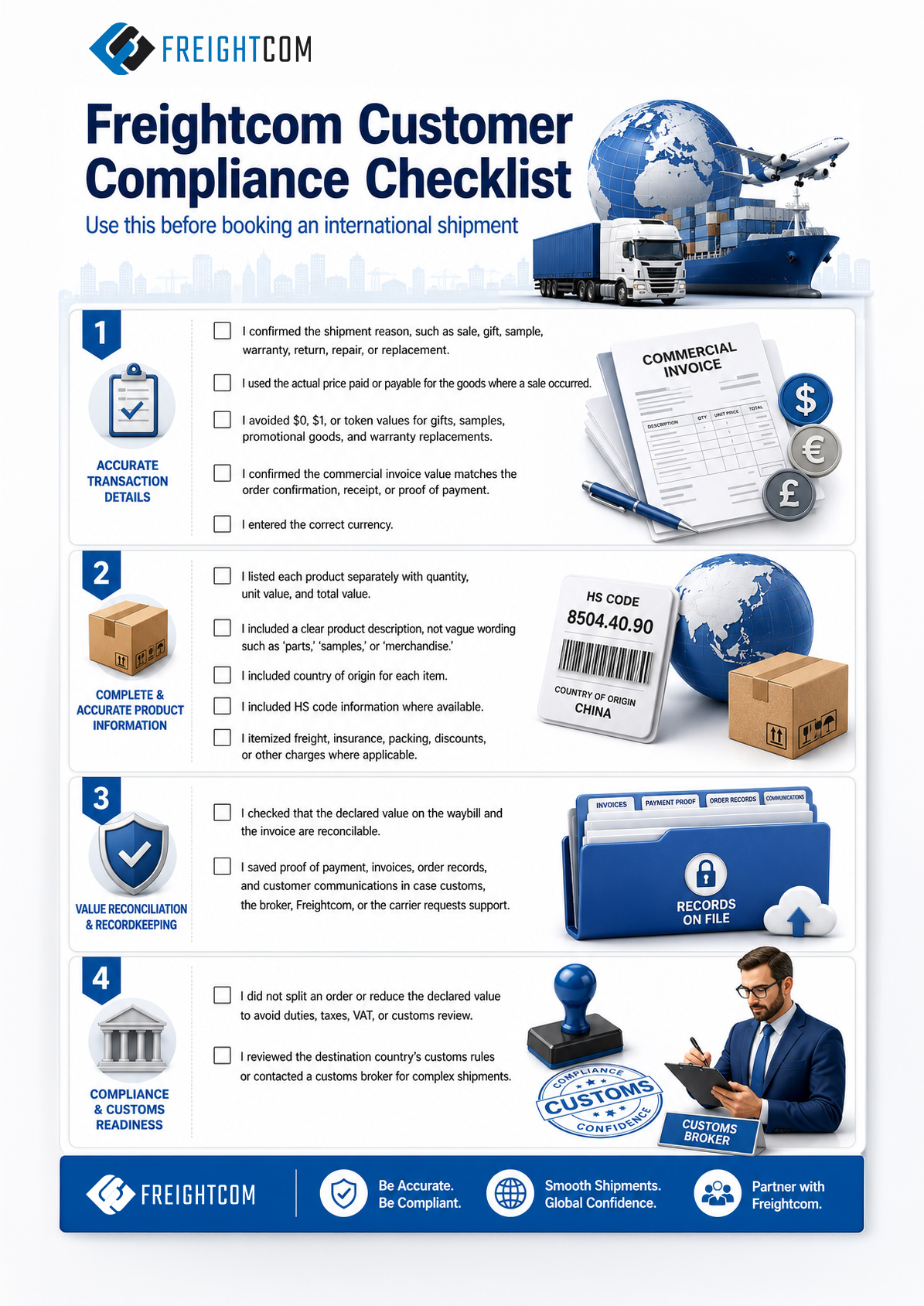
Freightcom Customer Compliance Checklist

What Happens if a Shipment Appears Undervalued?
If a shipment appears undervalued, customs authorities, brokers, carriers, or Freightcom could request additional support before clearance. This support could include proof of payment, order confirmations, product listings, invoices, or an explanation of how the value was calculated.
Depending on the situation, possible outcomes include:
- Clearance delays
- Shipment holds
- Inspection
- Corrected duties and taxes
- Additional brokerage or storage charges
- Penalties or fines
- Return to sender
- Account review or suspension
- Requirement for corrective action before future shipments move
Carrier guidelines also note that customers are responsible for the authenticity, accuracy, completeness, and timeliness of shipment information, and that carriers reserve rights such as requesting proof of payment, inspecting shipments, returning shipments, or suspending accounts where valuation concerns arise.
How Freightcom Customers Can Reduce Risk
Build a simple internal process for international orders:
- Pull the paid order value from your store, marketplace, or invoice system.
- Confirm the value by item, not only by shipment total.
- Match the commercial invoice to the order record.
- Keep proof of payment accessible.
- Train your fulfillment team not to change declared values based on customer requests.
- Use clear product descriptions and country of origin details.
- Ask a customs broker when the transaction is not straightforward.
This process protects your customer experience. It also helps reduce shipment holds, surprise charges, customs disputes, and avoidable account issues.
Resource links
For additional reference, review these customs valuation resources:
- WTO, Customs Valuation overview.
- World Customs Organization, WTO Valuation Agreement overview.
- CBSA, Customs valuation handbook.
- CBSA, Transaction Value Method of Valuation.
- CBP, commercial invoice value guidance.
- eCFR, 19 CFR 141.86 invoice requirements for U.S. imports.
- European Commission, customs valuation quick information.
- UPS, customs valuation checklist.
Closing Note
Accurate customs values help keep international shipments moving. Before booking, make sure the declared value reflects the true value of the goods and matches your supporting records. When in doubt, review the official customs resources or speak with a qualified customs broker before shipping.



.png?width=250&height=58&name=MicrosoftTeams-image%20(28).png "Freightcom")


