
EU Customs Changes at a Glance
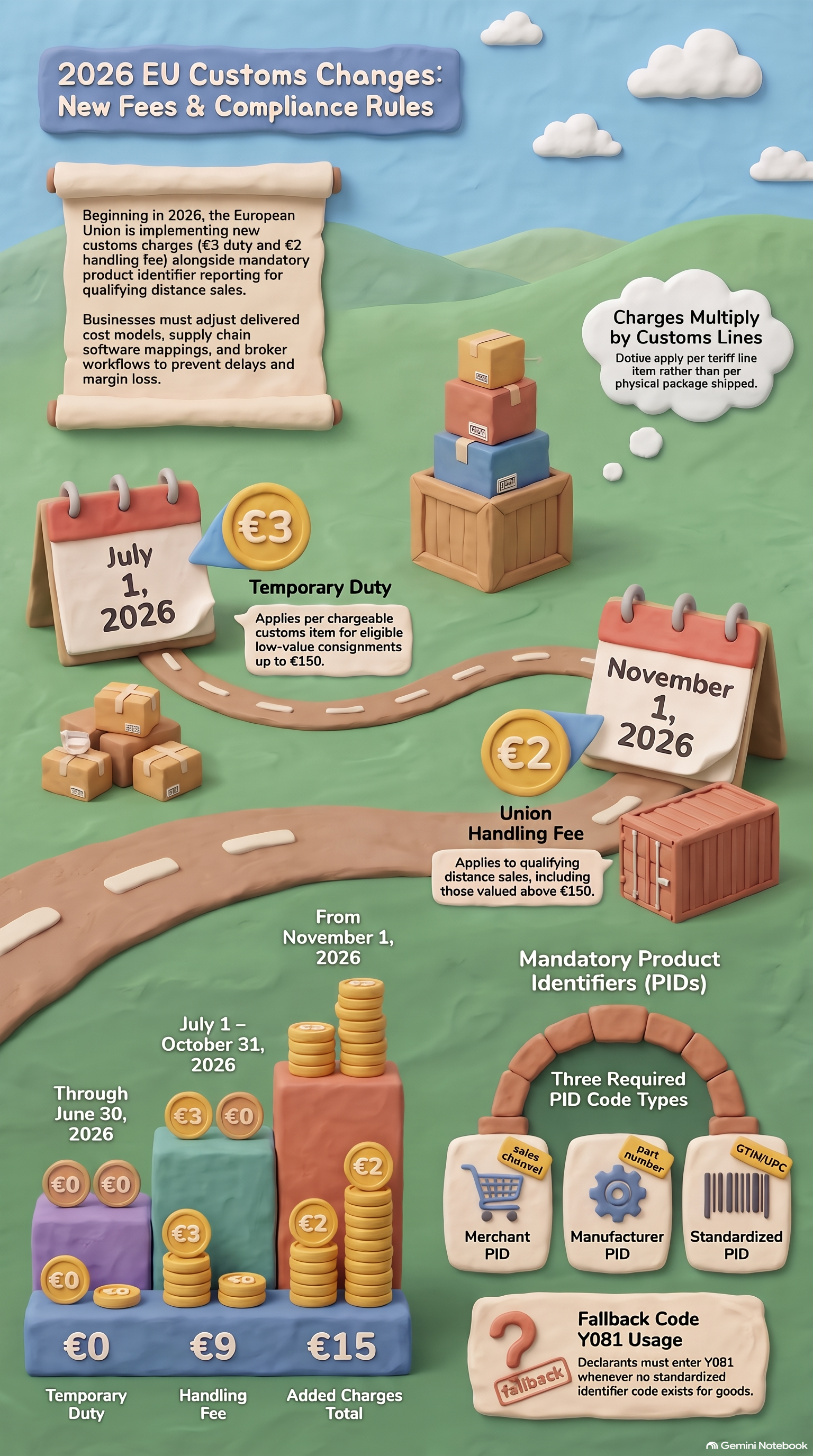
The EU customs changes set in place in 2026 have affected the cost and preparation of qualifying shipments from Canada, and in turn countless Canadian businesses. With further requirements arriving on November 1, businesses should review their delivered costs and clearance arrangements before the next changes take effect.
|
Date |
What changes |
Who needs to prepare |
|
July 1, 2026 |
Temporary €3 duty for each chargeable customs item |
Eligible consignments with intrinsic value up to €150 |
|
November 1, 2026 |
€2 Union handling fee |
Qualifying distance sales, including those above €150 |
|
November 1, 2026 |
Product identifier requirements |
Qualifying low value distance sales |
Who is affected: Canadian businesses sending qualifying shipments to EU customers. The treatment depends on the transaction, goods, value and import procedure.
Why it matters: New charges affect shipping budgets and customer quotations. Product data and payment arrangements need to support the service and delivery terms you offer.
What to do now: Review your shipment mix, confirm requirements with your carrier or broker and update product information and cost estimates.
To help keep you informed, this guide explains how to assess the impact of these upcoming changes, compare shipping options, and prepare your team for the revised process.
Start with the Transaction Behind the Shipment
The temporary duty applies to eligible consignments with an intrinsic value up to €150. The Union handling fee also covers qualifying distance sales above €150. The new product identifier requirements discussed here concern qualifying low-value distance sales.
Those differences matter when your business sends several types of shipments to Europe. Consumer orders, business purchases, inventory replenishment and returns need their own assessment. A low value consumer parcel estimate does not establish the treatment of a pallet carrying company stock.
Group your recent shipments by destination, buyer, purpose, goods and value. Have your customs broker confirm the treatment for each group and the clearance procedure you use. Keep EU destinations separate from other European markets in your pricing and shipping records.
This first review prevents a broad policy from reaching transactions requiring a different approach.
Understand How the Charges Reach Your Business
Transportation, customs duty, the Union handling fee, VAT and carrier or brokerage fees are separate components of the delivered cost. Request an itemized estimate so you understand what the shipping rate includes and which amounts arrive on another invoice.
The €3 duty follows customs item categories rather than a simple count of physical units. In the EU's published example, one silk blouse and two wool blouses create two tariff categories and €6 in duty.
Use the declaration structure confirmed for your goods when preparing a budget. The following examples assume eligible low value goods and correctly declared chargeable lines. They show the two government charges from 1 November, excluding VAT, transportation and service fees.
|
Chargeable customs lines |
Temporary duty |
Handling fee |
Combined charges |
|
1 |
€3 |
€2 |
€5 |
|
2 |
€6 |
€4 |
€10 |
|
4 |
€12 |
€8 |
€20 |
The effect becomes clearer across a recurring shipping flow. For 500 eligible consumer consignments averaging two chargeable lines each, these two charges total €5,000 if your business absorbs them. This illustrative budget excludes VAT and every other shipping cost. Your actual result depends on the transactions and declarations involved.
Use this calculation to review margins and customer agreements before increasing volume.
How the Same Order Costs More Through 2026
Consider a €100 order with three confirmed chargeable customs lines. The comparison below isolates the goods value and the two government charges for an eligible low value shipment. VAT, transportation, brokerage and carrier fees sit outside this illustration.
|
Cost component |
Through June 30 |
July 1 to October 31 |
From November 1 |
|
Goods value |
€100 |
€100 |
€100 |
|
Temporary duty |
€0 |
€9 |
€9 |
|
Union handling fee |
€0 |
€0 |
€6 |
|
Subtotal before VAT and other costs |
€100 |
€109 |
€115 |
By November, these two charges add €15 to this order before the remaining costs. If your business absorbs the amount, it reduces the money left from the sale. If you recover it from the customer, review the checkout or quotation total and how you explain the charge.
The example assumes the same goods value and declaration structure throughout. Your carrier or broker must confirm the actual chargeable lines and applicable procedure.
Compare Services Using the Total Delivered Cost
A lower transportation quote deserves attention, but the complete comparison includes what happens before and after the parcel moves. Add fuel and destination surcharges, customs charges, brokerage, final delivery costs and any shipping subsidy your business provides.
Include the work your team performs when something goes wrong. Product record corrections, clearance inquiries and refused deliveries consume time and reduce the return on the sale. Use your own shipment history to estimate these costs.
For recurring destinations, build one cost model for each service you regularly use. Compare the estimate with the final invoice and explain the difference. Finance should also distinguish recoverable taxes from costs your company ultimately absorbs, based on the applicable tax treatment.
This gives your shipping team a useful service comparison and gives your sales team a sounder basis for quoting customers.
Use a Complete Delivered Cost Worksheet
|
Cost component |
What to include |
Where to confirm it |
|
Transportation |
Base rate, fuel and destination surcharges |
Carrier quote and final invoice |
|
Government charges |
Applicable duty, handling fee and VAT treatment |
Broker assessment and tax review |
|
Clearance services |
Brokerage, advancement and other service fees |
Service agreement and invoice |
|
Fulfillment |
Packing, labour and shipping subsidies |
Your operating records |
|
Exceptions and returns |
Corrections, refusals and return handling |
Shipment and support history |
Record each component once to avoid double counting a charge already included in a quoted rate. Separate estimated amounts from confirmed amounts and retain the shipment reference connecting the quote, declaration and invoice.
Understand the Three Product identifiers
A product identifier is an alphanumeric code used to distinguish the product being sold. Your tariff code classifies the goods for customs. Keep both in your records. A tariff code does not replace the manufacturer reference or barcode.
Start with the three identifier types below. The examples describe the type of information to collect, rather than codes to copy into your catalogue.
|
Identifier |
Example |
General requirement |
Where to look |
|
Merchant PID |
Store or marketplace reference |
Required |
Sales channel product record |
|
Manufacturer PID |
Model or part number |
Required |
Supplier catalogue or packaging |
|
Standardized PID |
GTIN, EAN, UPC or ISBN |
Where one exists |
Manufacturer barcode record |
Verify which merchant reference your sales channel uses before mapping an internal SKU. Request manufacturer references from your supplier and preserve the original value in your product record. Avoid assigning the same model number to different products simply to complete a field.
Where no standardized identifier exists, the declarant uses Y081 as appropriate. An empty field needs a confirmed reporting treatment.
Check the Rules for Your Product Type
Special treatment depends on the applicable commodity code. Have your declarant confirm eligibility for conventional PID reporting.
|
Product group |
Treatment to check |
|
Ordinary manufactured goods |
Merchant and manufacturer PIDs, plus standardized PID where one exists |
|
Specified handmade goods |
Commodity-specific conventional PID reporting |
|
Unprocessed agricultural and perishable goods |
Commodity-specific conventional PID reporting |
|
Antiques, art and collectibles |
Commodity-specific conventional PID reporting |
|
Medical devices |
UDI-DI where applicable |
|
Medicines and OTC products |
Product code AI 01 where applicable |
|
Second-hand, refurbished and print-on-demand goods |
Standard PID requirements |
Use this table to identify which product records need closer review before dispatch. For regulated products, complete the separate product compliance review as well. A customs identifier does not establish permission to sell the goods.
Build a Product Record Your Team is Able to Reuse
Keep the approved merchant reference, supplier model, existing barcode, description, classification, origin and sale value together for each variant. A change to a supplier reference should trigger a review of the connected store and shipping records.
Assign your purchasing team to maintain supplier references, the trade compliance owner to confirm classification and origin, and your shipping team to check the transmitted record. For API or batch workflows, inspect what reaches the declarant, including rejected and corrected records.
Make Payment Responsibilities Part of the Customer Agreement
An inclusive customer price needs a working process behind it. Establish who handles the import, who pays each charge and how the carrier or broker collects payment before promising prepaid import costs.
Review your delivery terms with the broker and service provider. If you use DDP or DAP terms, confirm how the selected service supports the agreed responsibilities at the destination. Carry those arrangements through to the sales quote, booking instructions and customer communication.
The Import One Stop Shop, or IOSS, addresses VAT collection for eligible imported consignments up to €150. Confirm whether your business or a marketplace uses it and how the identifier reaches the declaration securely.
A handling fee passed to the consumer at sale forms part of the IOSS VAT base. Your finance team or your tax adviser should validate the full calculation before your business adopts an inclusive price.
Assess Canadian Origin Before Relying on CETA
CETA offers preferential tariff treatment for qualifying goods, subject to the product-specific origin rules and the required origin declaration. Shipping a product from a Canadian warehouse does not establish Canadian origin on its own.
Keep supplier and manufacturing evidence supporting the claim. Have your broker assess the available tariff treatment for the goods and the chosen import procedure before including a duty reduction in your customer price.
Product compliance deserves a separate check. Use the EU's Access2Markets resources to identify requirements for your goods, then resolve any restrictions with the appropriate adviser. Complete customs identifiers do not replace product safety or market access requirements.
Decide Whether EU Inventory Fits Your Business
Recurring EU demand creates a reason to compare direct shipping from Canada with holding stock closer to customers. The right choice depends on volume, delivery expectations and the full cost of operating each arrangement.
Direct shipping keeps inventory closer to your Canadian operation and avoids committing stock to another location. Holding EU inventory adds storage and working capital requirements while changing the fulfillment and returns process.
Build the comparison around your own demand pattern.
|
Factor |
Direct shipping from Canada |
Inventory held in the EU |
|
Cost base |
International shipment and clearance for each order |
Inbound freight, import costs, storage, picking and local delivery |
|
Delivery |
Depends on international transit and clearance |
Depends on local stock and fulfillment performance |
|
Cash commitment |
Stock stays within your Canadian operation |
Stock requires allocation and funding in another location |
|
Returns |
Requires an international return plan |
Requires local inspection, handling and disposition |
Include slow-moving stock, seasonal demand and the cost of maintaining inventory in two locations. Obtain a customs assessment of any consolidation or warehousing arrangement before treating it as a source of savings. Moving parcels together does not, by itself, determine their customs treatment.
Set a review point using observed volume or costs. A sustained increase in EU orders provides stronger evidence for changing the operating model than a short sales spike.
Put the Revised Process Through a Shipment Test
Before applying changes across your business, select shipments reflecting your main destinations and transaction types. Include examples with different products, values and delivery terms.
Follow each shipment from the customer order through booking, customs clearance and billing. Check whether the product information transfers correctly, the responsible party receives any clearance questions and the final charges match the agreed arrangement.
Resolve the exceptions before expanding the process. Record the fix where it belongs, whether in the product record, integration, booking rule or customer agreement. Assign a backup for clearance inquiries so an employee's absence does not interrupt a shipment.
Confirm how your service provider treats shipments booked before 1 November and declared afterward. Use the confirmed cutoff in your dispatch instructions instead of assuming the booking date determines the charge.
Prepare Each Team Before the Next Booking Cycle
|
Team |
Action |
Readiness check |
|
Purchasing and product |
Complete manufacturer references and variants |
Supplier evidence matches the approved record |
|
Shipping and broker |
Confirm procedure, required fields and billing |
Representative submissions are accepted |
|
IT or integration owner |
Verify the field mapping and error handling |
Rejected records are corrected before resubmission |
|
Sales and finance |
Review quotations, terms and total delivered cost |
Customer promises match collection arrangements |
|
Operations |
Assign clearance contacts and backups |
Requests reach someone able to resolve them |
Monitor the Costs Your First Estimate Missed
Connect the customer order, booking, declaration and final invoice with a common shipment reference. Your team then has a practical way to trace a billing difference or repeated clearance problem.
Review estimated versus actual delivered cost, customs exceptions, time in clearance, manual corrections and charges related to returns or refusals. Compare results by destination and service so your team knows where to focus.
During the initial rollout, review exceptions weekly and costs with finance each month. For low-volume destinations, examine the individual shipments alongside any percentages. Use the findings to improve the process before the same issue affects another customer.
EU Shipping Preparation Checklist
Use this checklist to confirm your team is ready to book, clear and reconcile EU shipments. Keep any unresolved item with a named owner before dispatch.
Shipment and Product Information
☐ Group EU shipments by destination, transaction type, goods, value and import procedure.
☐ Confirm who handles the declaration and which product fields your carrier or broker requires.
☐ Complete merchant references, manufacturer references and existing standardized identifiers for each variant.
☐ Retain classification and origin evidence, including support for any proposed CETA claim.
Costs and Customer Terms
☐ Complete a delivered cost estimate covering transportation, import charges, clearance services and exceptions.
☐ Have finance validate VAT treatment and separate recoverable taxes from costs your business absorbs.
☐ Check customer quotations and delivery terms against the agreed payment and carrier billing arrangements.
☐ Confirm the process and documents required for returns, refusals and any recovery of charges.
Operational Readiness
☐ Test representative bookings, including API or batch submissions where used.
☐ Verify how incomplete records are flagged, corrected and resubmitted.
☐ Link the order, booking, customs declaration and final invoice through a common shipment reference.
☐ Assign clearance contacts and backups, then schedule a review of the first shipments and invoices.
Frequently Asked Questions
Do the new charges apply equally to every shipment?
No. The transaction, goods, value and import procedure determine the assessment. Keep the temporary low value duty, handling fee, VAT and carrier charges separate in your review.
Does combining more goods always reduce customs costs?
The result depends on the underlying transactions and how the goods must be declared. Compare transportation savings with a broker-reviewed customs assessment before changing your fulfillment process.
Should we replace our current shipping service?
Start by identifying the source of the cost or delay. Better product information or a clearer billing arrangement might resolve the issue. Compare alternative services using complete shipment costs and the delivery standard your customers need.
Is IOSS the same as paying every import charge?
IOSS addresses VAT collection for eligible imported consignments. Confirm duty, handling fees and service charges separately when agreeing the complete amount your business or customer will pay.
Do handmade products have a blanket exemption?
Treat the product group table as a prompt for a classification check. Obtain the applicable reporting instructions for your actual goods before removing identifiers from the record.
What should we ask about returned orders?
Request a breakdown of which amounts are recoverable, which remain payable and which documents support any claim. Price the return transportation and handling work separately. A customer refund and recovery of import costs are different processes.
Review Your International Shipping with Freightcom
Freightcom offers carrier rate comparison and international courier shipping options to support your business. Bring your EU destinations, typical shipment values, product mix and delivery requirements to the Freightcom team to see how Freightcom can keep your shipping efficient, compliant, and affordable.

Official sources
European Commission: EU Customs Reform
Council of the European Union: Customs duty rules for small parcels
EUR-Lex: Product identifier requirements under Regulation (EU) 2026/1022
European Commission: Guidance on the €3 customs duty and Union handling fee
European Commission: VAT ecommerce explanatory notes
European Commission: CETA and export information for Canadian businesses
EUR-Lex: Union Customs Code and Union handling fee under Regulation (EU) 2026/2108